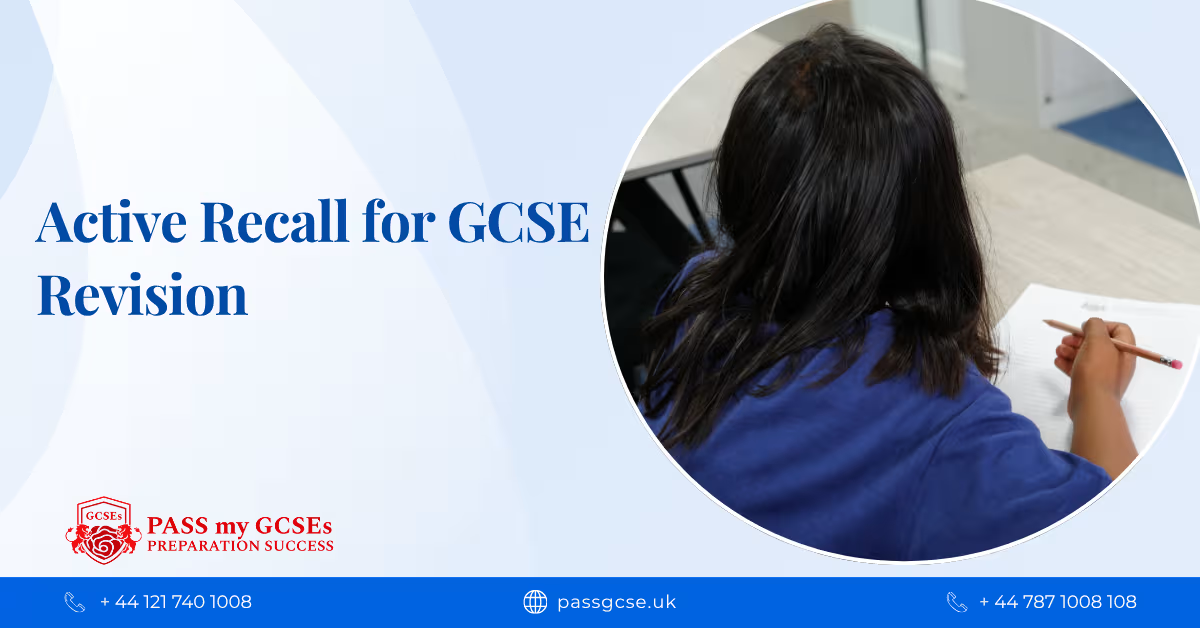
Active Recall for GCSE Revision: Does It Actually Work?
Published on
A page can look familiar without actually being learned, and that is exactly the trap most GCSE students fall into. You reread a page of notes, recognise every term and diagram, and close the book feeling prepared. Then in the exam, the detail you needed refuses to appear, because recognising something on a page and genuinely being able to retrieve it from memory are two completely different skills.
Active recall is the revision technique that closes that gap, and it is genuinely one of the most effective, well evidenced study methods available to GCSE students. This guide explains exactly what active recall is, why it consistently outperforms rereading, how to use it across different subjects, and how to build it into a revision routine that actually works.
Key Takeaways
Active recall means retrieving information from memory without looking at your notes, rather than simply rereading or highlighting, and it works by forcing the brain to genuinely search for an answer rather than just recognise it.
A 2024 research study (opens in a new tab) found a consistent positive link between active recall techniques, including flashcards, practice tests, and concept mapping, and stronger academic outcomes among students who used them.
Active recall works best combined with spaced repetition, reviewing material again at increasing intervals, since this is what actually moves information into long-term memory rather than short-term familiarity.
The exact technique should change by subject. Science and Maths respond well to retrieving methods and then applying them to problems, while essay-based subjects like English need you to recall thinking processes and question demands, not memorised paragraphs.
The most common mistake is only testing yourself on what already feels comfortable. The real value of active recall comes from deliberately targeting weak areas, not reinforcing what you already know.
What Is Active Recall?
Active recall is a revision strategy built around actively retrieving information from memory, rather than reading, highlighting, or copying from a textbook. Instead of simply reviewing material, you test yourself and see what you can genuinely remember without your notes in front of you.
This sounds like a small shift, but it makes a significant difference. Forcing your brain to search for an answer, rather than simply recognising it on a page, strengthens the memory and makes that information considerably easier to retrieve the next time you need it, including under exam pressure.
Why Active Recall Beats Rereading
When you try to remember something without looking at your notes, your brain has to genuinely search for that information, and each successful attempt strengthens the neural pathways connected to it, making it easier to retrieve in future. This is fundamentally different from rereading, which mainly relies on recognition rather than genuine retrieval.
A 2024 research study (opens in a new tab) reviewed a wide body of academic literature and found a consistent, positive link between active recall strategies, flashcards, practice testing, and concept mapping among them, and stronger academic achievement among students who used them regularly.
Active Recall | Passive Revision | |
Method | Retrieving information from memory, no notes | Rereading notes, watching videos, highlighting |
Timing | Long-term, starts well before exams | Short-term, often left until close to the exam |
Cognitive effort | High, forces genuine thinking and recall | Low, mainly recognition |
Memory retention | Strong, long-term | Weak, often just short-term familiarity |
Awareness of gaps | Clear, shows exactly what you don't know | Poor, hard to spot weak areas |
Exam preparation | Simulates real exam conditions | Less effective at building exam recall |
Confidence | Realistic, based on genuine recall ability | Often overestimates real understanding |
Examples of Active Recall in Action
Flashcards
Write a question or key term on one side and the answer or definition on the other, then test yourself regularly rather than simply flipping through them. This works particularly well for quick facts, definitions, and equations, and is most effective when used as part of a spaced revision pattern rather than a single cramming session.
Blurting
Revise a topic, then close your notes and write down everything you can remember about it on a blank page. Once finished, check what was missed against your notes and revisit it again later. This is one of the fastest ways to see exactly how much of a topic has genuinely stuck.
Practice Questions
Use past papers or exam-style questions to test your knowledge directly, answering without notes before checking and reviewing any mistakes against the real mark scheme. This is particularly valuable because it tests not just recall, but your ability to apply that knowledge the way an exam actually demands.
Teaching Others
Explain a topic to someone else, a friend, sibling, or parent, without referring back to your notes. If you can explain it clearly and answer questions about it, you have almost certainly learned it well enough to tackle it in an exam.
How to Use Active Recall in Your Revision Routine
A simple, repeatable routine makes active recall genuinely sustainable, rather than something that only happens occasionally.
Learn the topic first, using your notes, a textbook, or a revision guide
Test yourself using flashcards, blurting, practice questions, or another active technique, with no notes open
Check what you got wrong or missed, using your notes or the official mark scheme
Identify your weakest areas, the topics or question types where the most mistakes happened
Review your notes again, focusing specifically on those weaker areas rather than everything equally
Repeat regularly, so information stays fresh and genuinely moves into long-term memory
Mix subjects and topics together, a technique called interleaving, which keeps revision varied and builds the flexibility needed to switch between topics in a real exam
Combining Active Recall With Spaced Repetition
Active recall becomes significantly more powerful when paired with spaced repetition, reviewing material again at increasing intervals, for example on day 1, then day 3, then day 6, then day 10. This pattern of repeated retrieval is what actually strengthens memory over time and builds the ability to recall information quickly and accurately, rather than having to relearn it from scratch each time.
Waiting too long between sessions undermines this. If a topic is left too long before being revisited, it has to be relearned rather than simply refreshed, which wastes far more time and effort than a shorter, more frequent review would have taken.
How to Apply Active Recall Across Different GCSE Subjects
Active recall works across every GCSE subject, but exactly what you retrieve, and how you apply it, needs to shift depending on what the subject actually demands.
Maths and Science
For Maths and the sciences, active recall works best when it covers both content and method. Retrieve key definitions, formulae, and required practical details from memory first, then immediately apply that knowledge to a genuine practice question. Recalling a formula on its own is not the same as being able to identify when to use it, apply it correctly, and communicate your working clearly, so recall and application need to be treated as two connected steps, not one.
Essay-Based Subjects Like English
English Language and English Literature are skills-based subjects, which means active recall needs to focus on more than isolated definitions. Rather than memorising a model paragraph and hoping it fits whatever question comes up, build recall prompts around the thinking process itself: What is the question actually asking? Which skill does it assess? What does a specific word or technique suggest in this context? Is there another valid interpretation? This keeps your recall flexible enough to genuinely respond to an unfamiliar extract or question, rather than forcing every answer into the same rehearsed shape. A smaller, precisely understood set of techniques and terms is consistently more valuable than a long list of sophisticated labels you cannot confidently apply.
Humanities and Content-Heavy Subjects
For subjects like History, Geography, and Religious Studies, active recall works well for dates, case studies, key terms, and named examples, but should always be followed by applying that knowledge to an exam-style question, since these subjects reward using evidence to build an argument, not simply listing facts.
Common Mistakes to Avoid
Rereading or copying notes instead of testing yourself. This feels productive, but it does not challenge your brain to retrieve information, which means it builds far weaker long-term memory than genuine active recall.
Waiting too long before reviewing. Leaving too long a gap between sessions means information has to be relearned rather than simply refreshed, wasting valuable time and effort.
Only testing yourself on topics you already know. It is tempting to focus on what already feels comfortable, but the biggest improvements come from deliberately challenging yourself on the material you find hardest.
Not checking or correcting your mistakes. Testing yourself is only half the process. Reviewing exactly where and why an answer went wrong is what actually drives improvement.
Treating flashcards as the whole method. Flashcards are one tool among several, not the definition of active recall itself. Blurting, practice questions, teaching others, and reconstructing a blank exam paper from memory are all equally valid, and mixing formats keeps revision from becoming stale.
Stopping at recall and never applying it. Especially in skills-based subjects, retrieving a definition or method is not the same as being able to use it under real exam conditions. Recall should always lead into genuine practice, not replace it.
Getting More Support With Active Recall Revision
Understanding active recall is a strong starting point, but building it into a genuinely effective routine, one tailored to each subject's real demands and your own specific weak areas, is where consistent, structured support makes the biggest difference. Our GCSE revision courses are designed by examiners around exactly the techniques and priorities most likely to move a grade, giving active recall a properly sequenced path through the specification rather than scattered, self-directed practice.
For genuine, exam board matched material to apply your recall to, our GCSE past papers collection brings together real papers across every core subject. Our GCSE mock exams give students the chance to put active recall to the test under full, timed exam conditions with detailed, examiner style feedback. And for students who need focused, one to one support turning active recall into consistently stronger exam answers, our GCSE tutors work directly with students to identify exactly where retrieval practice should be focused next.
GCSE REVISION TUITION
Want a Revision Plan That Actually Works?
Get expert one-to-one tuition and a personalised study plan built around your child's subjects and goals.
Conclusion
Active recall works because it forces your brain to genuinely retrieve information rather than simply recognise it, and that single shift in approach is consistently more effective than rereading, highlighting, or passively reviewing notes. Combined with spaced repetition, applied correctly to the specific demands of each subject, and paired with honest, consistent checking of your mistakes, active recall turns revision from something that merely feels productive into something that genuinely moves a grade. Start small, test yourself on one topic today, check what you missed, and build the habit from there.
Frequently Asked Questions
Is active recall backed by science?
Yes. Research consistently links active recall techniques, including flashcards, practice testing, and concept mapping, to stronger academic outcomes. A 2024 research study (opens in a new tab) specifically found a positive correlation between these techniques and student performance on real exams.
Do I need flashcards to use active recall?
No. Flashcards are just one method among several. Blurting, practice questions, teaching others, and reconstructing a blank exam paper from memory are all equally valid forms of active recall, and mixing different formats often keeps revision more engaging.
How often should I use active recall?
Ideally, regularly throughout your entire revision schedule, combined with spaced repetition rather than used once and forgotten. Starting active recall as soon as you first learn a topic, rather than saving it for the final weeks before exams, gives you the best chance of transferring information into long-term memory.
Can active recall work for essay-based subjects like English?
Yes. Active recall works well for English, but it needs to focus on more than definitions and terminology. Recalling question requirements, analytical thinking processes, and flexible planning decisions, rather than memorised paragraphs, keeps your knowledge adaptable enough to respond to whatever extract or question actually appears.
Is active recall better than past papers?
They work best together, not as alternatives. Active recall builds genuine, retrievable knowledge of content and method, while past papers test whether that knowledge can actually be applied under real exam conditions, with proper timing, structure, and exam technique. Neither fully replaces the other.

Mr Singh
Founder, Pass My GCSE
Mr Singh is the founder of Pass My GCSE, with over 30 years of teaching experience. Having overcome academic setbacks himself, he is passionate about ensuring no child struggles alone. His approach focuses on personalised support, strong foundations, and building confidence. He has helped students achieve outstanding results in 11+ and GCSE examinations
Loading related posts…
Ready to Transform Your Child's GCSE Results?
Join hundreds of Birmingham families who trust Pass My GCSE to deliver real, measurable results.