Loading page…
GCSE AQA Maths: Everything You Need to Know
Published on
If your school has entered you for AQA GCSE Maths, knowing exactly what the exam looks like before you walk into the hall makes a genuine difference to how confident you feel on the day. Exam boards structure and mark their papers slightly differently from one another, so understanding AQA's specific format, question style, and grading approach is time well spent long before revision season begins.
This guide covers everything you need to know about AQA GCSE Maths: how the three papers are structured, what separates Foundation from Higher tier, the kinds of questions you will face, how grade boundaries actually work, what examiners are really looking for, and exactly what to bring with you on exam day.
Key Takeaways
AQA GCSE Maths is assessed across three papers, one non-calculator and two calculator, each worth 80 marks and counting equally towards a third of your final grade.
Grade boundaries are set after each exam series based on how the cohort performed, so the exact mark needed for a given grade shifts slightly year to year.
A formula sheet is provided in every AQA Maths exam for the 2025, 2026, and 2027 series, covering things like the quadratic formula and Pythagoras' theorem.
Every question is written to test one or more of three Assessment Objectives: applying standard techniques, reasoning and communicating, and solving problems in unfamiliar contexts.
Genuine AQA past papers remain the single most effective way to prepare, since they build familiarity with exactly how AQA words and marks its questions.
What's the Format for AQA GCSE Maths?
AQA GCSE Maths, specification 8300, is assessed across three exam papers at both Foundation and Higher tier. All content from the specification can be tested in any of the three papers, and questions frequently combine several topics together rather than testing one area in isolation.
Paper | Type | Length | Marks | Weighting |
|---|---|---|---|---|
Paper 1 | Non-calculator | 1 hour 30 minutes | 80 | 33.3% |
Paper 2 | Calculator | 1 hour 30 minutes | 80 | 33.3% |
Paper 3 | Calculator | 1 hour 30 minutes | 80 | 33.3% |
Each paper carries exactly equal weight towards the final grade, which means there is no single paper that matters more than the others, and a weaker performance on one paper can still be balanced out by strong performances on the other two.
What's the Difference Between Foundation and Higher Tier?
The format of the papers themselves is identical across both tiers, three papers, 80 marks each, 90 minutes long. What genuinely differs is the difficulty of the content and the grades available.
Foundation tier covers the essential topics needed for further study, work, and everyday life, and allows students to achieve grades 1 through 5, but no higher. Higher tier covers more advanced content, including more complex algebra, higher-level geometry, and deeper work with functions, and allows grades 3 through 9, but no lower.
Schools place students into the correct tier based on performance during Year 9, though students can sometimes move between tiers during Year 10 or 11 if their performance changes. It is worth knowing that AQA requires every paper to be sat at the same tier, it is not possible to sit Higher tier for one paper and Foundation for another.
What Does the Exam Paper Actually Look Like?
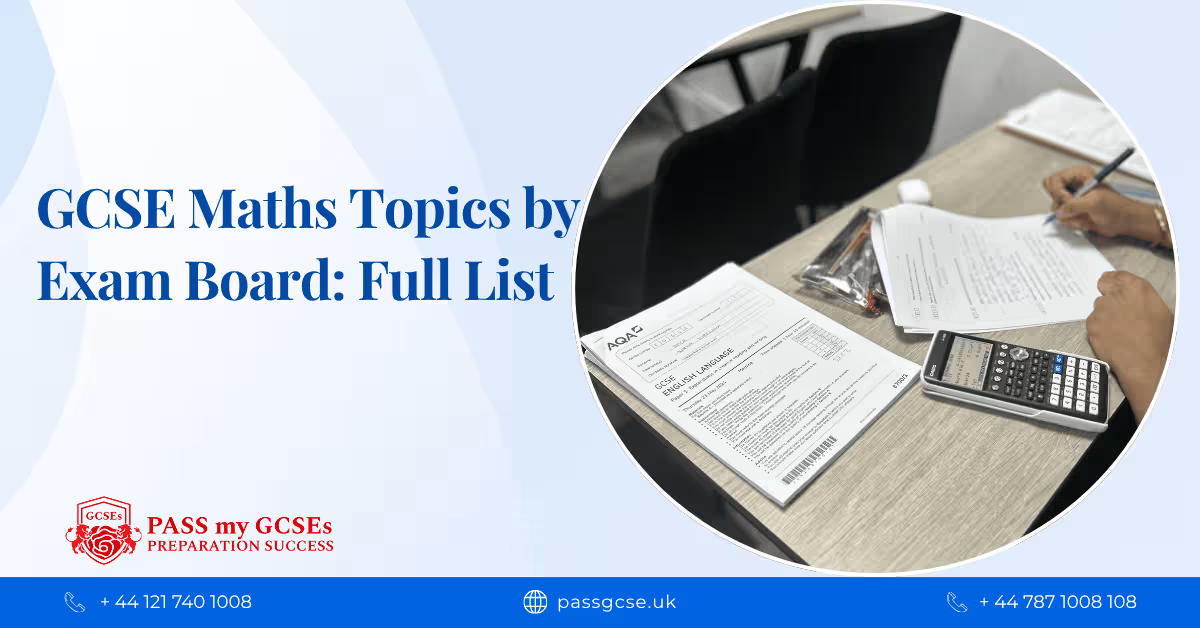
Each AQA Maths paper includes an instructions page, where personal details are filled in and exam guidance is given, a question booklet containing every question with space to write answers and working, and additional pages at the back for extra working out if needed. If extra working space is used, writing the question number clearly in the margin matters, since this is how examiners connect that working back to the right question.
What Kinds of Questions Will I Face?
Every AQA paper mixes question styles, and difficulty generally increases as the paper progresses. Understanding how marks are distributed across different question types helps with both revision focus and exam timing.
1-mark questions are typically simple recall or single-step arithmetic, things like converting a fraction to a decimal or calculating a straightforward percentage. These rarely need extended working, though showing it protects against a careless slip, and they are designed to build early confidence in the paper.
Medium-mark questions, worth 2 to 5 marks, require a few more steps and genuine understanding. These often need intermediate working shown, and the mark scheme awards both method marks, for the correct approach, and accuracy marks, for the correct final answer.
Higher-mark, multi-step questions, worth 6, 7, or 8 marks, combine several areas of maths, algebra, geometry, statistics, or ratio, within a single question, often in an unfamiliar context. These frequently include command words like "show that," "explain why," or "justify," and genuinely require a clear, structured method rather than a single calculation. Marks here split between method and accuracy, and partial credit remains available even when the final answer is wrong, provided the working shown is valid.
What Are the Grade Boundaries for AQA Maths?
Grade boundaries are not fixed figures, they are set after each exam series based on how the cohort performed and how difficult that year's papers turned out to be. This process exists specifically so a grade awarded in a harder year reflects the same underlying standard as the same grade awarded in an easier one.
Based on recent AQA Maths series, grade 9 has typically required somewhere between 214 and 219 marks out of 240 on Higher tier, grade 8 between 184 and 191, and grade 7 between 157 and 164. A standard grade 4 pass on Higher tier has recently sat in the low 60s, around 61 to 63 marks. On Foundation tier, grade 5 has required roughly 186 to 188 marks, with grade 4 sitting around 150 to 160.
Year on year movement in these boundaries is usually modest rather than dramatic, and exam boards work specifically to keep grading fair and consistent across different cohorts. If results genuinely do not reflect expected performance, a remark can be requested, though it is worth knowing that a remark can lower a mark as well as raise it.
What Key Topics Do I Need to Know?
AQA GCSE Maths is organised into six content areas, and a thorough understanding of each one matters, since questions frequently blend topics together rather than testing them separately.
Number covers units of measure, fractions, prime numbers, and core numerical skills
Algebra covers expanding and simplifying expressions, plotting and interpreting graphs, and solving equations
Ratio, Proportion and Rates of Change covers compound units, scale diagrams, and direct and inverse proportion
Geometry and Measures covers angle properties, coordinate axes, and transformations including rotation, reflection, translation, and enlargement
Probability covers the probability scale, likelihood of outcomes, and tree diagrams
Statistics covers interpreting and constructing charts and graphs, understanding population data, and correlation
Students taking Further Maths alongside GCSE Maths will also cover additional content, including functions, coordinate geometry, calculus, and matrix transformations.
What Are Examiners Actually Looking For?
AQA examiners are not simply checking whether a final answer is correct, they are assessing how a student thinks. Every question is written to test one or more of three Assessment Objectives, and understanding what each one actually rewards changes how an answer should be approached.
AO1, applying standard techniques, rewards accuracy in calculations, correct use of formulae, and clear working. This covers most number work, algebraic manipulation, and geometry questions, and credit is available for a correct method even where a calculation slip produces the wrong final answer.
AO2, reasoning, interpreting and communicating, rewards the ability to explain why something works, not just how to do it. This might involve comparing results, interpreting a graph, or explaining a relationship between numbers, and clear, well-presented reasoning is weighted just as heavily as reaching the correct answer.
AO3, solving problems in context, rewards applying maths to unfamiliar or real-life situations, choosing the right method, linking different areas of the specification together, and making sense of the final answer. These questions often require several steps and reward logical reasoning throughout, not simply the final figure.
Approaching every question step by step, showing working clearly, and checking that an answer genuinely makes sense in context is consistently what separates strong answers from average ones, regardless of which Assessment Objective a question is targeting.
How Can I Prepare for AQA Maths?
Use Genuine Past Papers
Practising with real AQA past papers and mark schemes is one of the most effective ways to prepare, since it builds familiarity with exactly how AQA words its questions, how marks are awarded, and what real exam timing actually feels like. Working consistently through genuine GCSE AQA Maths past papers is far more valuable than generic practice questions that do not reflect the board's actual style.
Know What to Bring on Exam Day
For Paper 1, the non-calculator paper, you will need a black pen, with spares, a pencil, ruler, rubber, and sharpener, plus a protractor and compass for geometry questions. For Papers 2 and 3, bring everything above plus a scientific calculator that meets exam board regulations, checked beforehand to make sure it is working properly and that you are confident using every function you might need.
Beyond subject-specific equipment, a clear pencil case, a labelless bottle of water, a jumper in case the exam hall runs cold, and glasses or any required medication, such as an inhaler, packed the night before all help remove unnecessary stress from exam morning.
Know the Formula Sheet
A formula sheet is provided in every AQA Maths exam, confirmed for the 2025, 2026, and 2027 series, which means formulae such as the quadratic formula, Pythagoras' theorem and trigonometry, and coordinate geometry formulae do not need to be memorised from scratch. That said, genuine familiarity with the sheet, knowing exactly where to find each formula and how to apply it confidently, still needs to be built through practice, since hunting for the right formula under exam pressure costs valuable time.
Getting More Support With AQA Maths
Understanding the format, question styles, and Assessment Objectives is a strong starting point, but turning that understanding into real exam performance usually comes down to consistent, targeted practice. Our GCSE Maths past papers collection, alongside our wider GCSE past papers resource, brings together genuine AQA papers so revision time is spent on material that reflects exactly what you will face on the day.
For a properly structured path through the specification, our GCSE revision courses are designed by examiners around the topics and skills most likely to move a grade. And for students who want focused, one to one support on AQA specifically, our GCSE Maths tutors work directly with students on exactly the question styles, command words, and Assessment Objectives that AQA rewards. If you are aiming for the very top grade, our guide on how to get a grade 9 in GCSE Maths covers the exam technique that makes the real difference.
GCSE AQA MATHS TUITION
Want to Know Exactly Where You Stand?
Get expert one-to-one tuition from AQA specialists, with a plan built around the exact papers and tier you're sitting.
Conclusion
AQA GCSE Maths is assessed across three equally weighted papers, one non-calculator and two calculator, with content spanning six core areas and questions built around three clear Assessment Objectives. Grade boundaries shift slightly each year to keep grading fair, a formula sheet is provided throughout the current series, and genuine, consistent past paper practice remains the most reliable way to prepare. Knowing exactly what to expect, from paper structure to exam day essentials, removes a great deal of unnecessary uncertainty, leaving far more room to focus on the maths itself.
Frequently Asked Questions
How many papers are there in AQA GCSE Maths?
There are three papers at both Foundation and Higher tier, one non-calculator and two calculator, each 1 hour 30 minutes long and worth 80 marks, with each paper counting equally towards a third of the final grade.
Is a calculator allowed in AQA GCSE Maths?
A calculator is allowed for Papers 2 and 3, but not for Paper 1. Any calculator used must meet exam board regulations, and it is worth checking it is in good working order with fresh batteries well before exam day.
Is there a formula sheet in AQA GCSE Maths?
Yes. A formula sheet is provided in every AQA Maths exam, confirmed for the 2025, 2026, and 2027 series, covering formulae such as the quadratic formula, Pythagoras' theorem, trigonometry, and coordinate geometry.
What is the difference between Foundation and Higher tier in AQA Maths?
The exam format is identical, three papers, 80 marks each. Foundation tier covers essential content and allows grades 1 to 5, while Higher tier covers more advanced topics, including complex algebra and higher-level geometry, and allows grades 3 to 9. All three papers must be sat at the same tier.
Where can I find genuine AQA GCSE Maths past papers?
Genuine past papers and mark schemes are available directly from AQA, though only a limited number of recent series remain accessible at any time due to copyright restrictions. Our GCSE Maths past papers collection brings together a wider range of genuine AQA papers, organised by tier, for more complete practice.

Mr Singh
Founder, Pass My GCSE
Mr Singh is the founder of Pass My GCSE, with over 30 years of teaching experience. Having overcome academic setbacks himself, he is passionate about ensuring no child struggles alone. His approach focuses on personalised support, strong foundations, and building confidence. He has helped students achieve outstanding results in 11+ and GCSE examinations
Loading related posts…
Ready to Transform Your Child's GCSE Results?
Join hundreds of Birmingham families who trust Pass My GCSE to deliver real, measurable results.