Loading page…
The 5 Hardest GCSE Maths Topics and How to Beat Them
Published on
GCSE Maths can be a tricky subject.
Some topics seem easy when the teacher explains them in class. Then you see a question in an exam and suddenly think, "What am I supposed to do?"
If this sounds familiar, do not worry. You are not alone.
Some GCSE Maths topics are harder than others because they involve several steps, tricky formulas or questions that test your thinking instead of simple calculations.
The good news is that hard does not mean impossible.
With the right practice, clear explanations and regular support, you can get better at even the most difficult GCSE Maths topics.
At Pass GCSE, our GCSE Maths tuition is designed to help students understand difficult topics, close knowledge gaps and build confidence. We support both Foundation and Higher Tier students and align our teaching with major UK exam boards, including AQA, Edexcel, OCR, WJEC and Eduqas.
In this guide, we look at 5 of the hardest GCSE Maths topics and explain how you can beat them.
What Makes a GCSE Maths Topic Difficult?
Before we look at the five topics, it is worth understanding why some areas of Maths feel harder.
A topic can be difficult because:
It has lots of rules to remember
You need to use several steps
The questions can look different each time
You need to understand the problem before calculating
One small mistake can affect the final answer
You need to use knowledge from more than one topic
This is especially common in Higher Tier GCSE Maths, where students face more advanced algebra, trigonometry, geometry and problem-solving.
But there is a simple way to deal with difficult topics.
Break them into smaller parts, learn the method, practise it and then try exam-style questions.
That is exactly the kind of approach we use at Pass GCSE.
1. Algebra
Algebra is one of the biggest parts of GCSE Maths, and it can be one of the most challenging.
At first, algebra may look like letters mixed with numbers.
You might see:
3x + 5 = 17
and think, "Why are there letters in Maths?"
But algebra is simply a way of using letters to represent numbers we do not know yet.
As you move through GCSE Maths, algebra becomes more advanced. Students may need to work with:
Simplifying expressions
Expanding brackets
Factorising
Linear equations
Inequalities
Sequences
Simultaneous equations
Functions
Algebraic reasoning
These areas are included in our GCSE Maths curriculum, with more advanced algebra and functions forming part of Higher Tier support.
How to Beat Algebra
Do not try to learn everything at once.
Start with the basics.
For example:
Step 1: Learn how to collect like terms.
Step 2: Practise expanding brackets.
Step 3: Learn factorising.
Step 4: Move on to equations.
Step 5: Practise multi-step problems.
Once the basics become automatic, harder questions become much easier.
At Pass GCSE, our tutors explain algebra step by step and then use practice questions to help students apply what they have learned.
If algebra is one of your weak areas, our GCSE Maths tutors can help you build your skills from the ground up.
2. Trigonometry
Trigonometry can be a major challenge, especially for Higher Tier students.
You may have heard of:
SOH CAH TOA
This helps students remember the three main trigonometric ratios:
Sine
Cosine
Tangent
But remembering the formula is only the first step.
You also need to know:
Which ratio to use
Which sides of the triangle are involved
Whether your calculator is in the correct mode
How to rearrange the calculation
How to round your answer
How to deal with more complicated problems
Trigonometry also connects with other parts of geometry and problem solving.
How to Beat Trigonometry
Start by drawing the triangle.
Then label:
Opposite
Adjacent
Hypotenuse
Next, identify what information you already have and what you need to find.
Then choose the correct ratio.
Do not rush straight to the calculator.
A common mistake is pressing buttons without understanding what the calculation is doing.
At Pass GCSE, our Higher Tier Maths tuition includes trigonometry and geometry problem-solving. We focus on helping students understand the method instead of simply memorising formulas.
If you want more focused support before your exams, our GCSE Maths Higher Revision Course provides structured revision across key GCSE Maths topics.
3. Geometry and Circle Theorems
Geometry is another topic that can feel confusing.
There are shapes, angles, diagrams, measurements and formulas to remember.
Then there are questions where you have to work out what information the diagram is giving you.
Higher Tier students may also have to deal with circle theorems.
This can be difficult because the question may not directly tell you which theorem to use.
You have to recognise the pattern.
For example, you may need to understand relationships involving:
Angles in circles
Tangents
Chords
Angles at the centre
Angles in the same segment
Cyclic quadrilaterals
How to Beat Geometry
The first rule is simple.
Draw and label the diagram carefully.
Do not ignore the information already given.
Look for:
Equal angles
Parallel lines
Right angles
Equal sides
Known lengths
Circle properties
Then ask yourself:
"What rule can I use here?"
The more questions you practise, the easier it becomes to recognise the patterns.
Our GCSE Maths tutors cover geometry, transformations, measurements and problem-solving as part of the wider GCSE Maths curriculum.
With regular practice, a page full of shapes can start to look much less scary.
4. Probability and Statistics
Probability and Statistics can look simple.
You might think:
"Surely this is just about averages and chances?"
Not always.
GCSE students can be asked to interpret data, calculate averages, understand probability and solve questions using different forms of information.
Topics can include:
Mean
Median
Mode
Charts and graphs
Probability
Statistical analysis
Data interpretation
These areas are included in our GCSE Maths tuition programme.
The difficult part is often understanding what the question is asking.
A question may give you a table, chart or diagram and ask you to find something from it.
How to Beat Probability and Statistics
Do not rush.
Read the question carefully.
Write down the information you have.
Then decide what you need to calculate.
For probability questions, remember that probability is about how likely something is to happen.
For statistics questions, make sure you understand the data before doing any calculations.
Practice is especially important here because exam questions can be written in many different ways.
Our GCSE Revision Courses give students structured opportunities to revisit important topics, practise exam-style questions and understand where marks are gained or lost.
5. Multi-Step Problem Solving
This may be one of the hardest parts of GCSE Maths because there is no single formula that works every time.
Instead, you need to think.
A problem-solving question might include:
A percentage calculation
A ratio
Algebra
Measurements
A graph
Geometry
Several steps in one question
The question may look long and complicated.
But the secret is to break it down.
How to Beat Problem Solving
Use this simple method:
1. Read the question carefully.
Do not immediately start calculating.
2. Underline important information.
Look for numbers, units and key words.
3. Work out what you need to find.
What is the question actually asking?
4. Break the problem into smaller steps.
Do not try to solve everything in your head.
5. Show your working.
Your working can help you earn method marks and can also make it easier to spot mistakes.
6. Check your answer.
Ask yourself whether your answer makes sense.
This is one of the areas where an experienced GCSE Maths tutor can make a big difference.
At Pass GCSE, we include problem-solving and exam techniques in our Maths tuition because we want students to know not just how to do Maths, but how to use their Maths knowledge in an exam.
Which GCSE Maths Topics Should You Revise First?
If you are not sure where to start, do not simply revise the topics you like.
Start with your weak areas.
A useful revision plan could look like this:
Topic | What to Practise |
Algebra | Equations, factorising, sequences and functions |
Trigonometry | SOH CAH TOA and problem solving |
Geometry | Angles, shapes, measurements and circle theorems |
Statistics | Averages, graphs and data |
Probability | Probability calculations and reasoning |
Problem Solving | Multi-step GCSE exam questions |
You should also spend time practising topics you already understand. This helps keep your knowledge fresh.
How Pass GCSE Helps Students Beat Difficult Maths Topics
At Pass GCSE, we know that every student learns differently.
Some students need help with the basics.
Some students understand the topics but struggle with exam questions.
Others are aiming for Grades 7, 8 or 9 and need more challenging questions.
That is why our GCSE Tutor programme starts by understanding the student's current level, gaps and goals.
Our GCSE Maths tuition includes:
Foundation and Higher Tier support
Personalised learning plans
Major UK exam board support
Past paper practice
Exam technique
Online and in-person sessions
One-to-one and group options
Regular progress reviews
Our Maths page currently reports a 97% success rate and more than 30 years of teaching expertise.
We Do Not Just Teach the Answer
One of the biggest mistakes students can make is trying to memorise answers.
That might help with one question.
But GCSE exams can change the wording.
They can change the numbers.
They can put the same Maths skill into a completely different situation.
This is why we focus on understanding.
For example, instead of simply saying:
"Use this formula."
We want students to understand:
Why do I use this formula?
What information do I need?
How do I set it up?
What should I do if the question looks different?
That understanding can help students tackle unfamiliar questions with greater confidence.
Past Papers Can Turn Weak Areas Into Strong Areas
Once you understand a topic, you need to practise it.
This is where past papers are very useful.
Our GCSE Past Papers resources can help students become familiar with GCSE-style questions and exam formats.
But there is a better way to use past papers.
Do not just look at your final score.
Look at your mistakes.
If you lose marks on algebra, go back and revise algebra.
If you struggle with geometry, practise geometry.
If you run out of time, work on exam pacing.
Every mistake can give you useful information about what to revise next.
Mock Exams Can Help You Prepare for the Real Thing
Knowing the Maths is important.
Being able to use it under exam conditions is also important.
This is why mock exams are an important part of good GCSE preparation.
Our GCSE Mock Exams give students an opportunity to practise before the real exam.
For students who want focused Maths preparation, our GCSE Maths Mock Exams can help them practise working under timed conditions and understand where they need more preparation.
Mock exams can help students understand:
How well they manage time
Which topics need more revision
Whether they make careless mistakes
How they cope with exam pressure
Where they can improve their marks
The goal is not simply to get a high mock score.
The goal is to learn from the experience and improve before the real GCSE exam.
A Simple GCSE Maths Revision Plan
If you are preparing for GCSE Maths, try this simple weekly plan.
Monday: Learn
Choose one difficult topic and learn the method.
Tuesday: Practise
Complete basic questions until you feel comfortable.
Wednesday: Challenge Yourself
Try harder GCSE-style questions.
Thursday: Fix Mistakes
Look at questions you got wrong and understand why.
Friday: Past Paper Practice
Complete a selection of questions from a past paper.
Weekend: Review
Go back over the topics you found difficult during the week.
If you need extra support, our GCSE Maths tuition can provide a more structured learning plan based on your child's needs, exam board and target grade.
What If My Child Is Struggling With GCSE Maths?
The worst thing a student can do is decide:
"I'm just bad at Maths."
Maths is a skill.
Skills improve with practice.
If your child is struggling, the first step is to find out why.
Are there gaps in their basic knowledge?
Do they struggle to understand questions?
Are they making calculation mistakes?
Do they understand the topic but struggle under time pressure?
Once you know the problem, you can work on the solution.
At Pass GCSE, we start with an assessment of a student's current level, gaps and goals. We then create a personalised learning plan around their syllabus, weak areas and exam timeline.
That means students do not have to spend all their time revising things they already know.
They can focus on the areas where they need the most help.
Get Ahead of the Hardest GCSE Maths Topics With Pass GCSE
The hardest GCSE Maths topics do not have to become the topics that cost you marks.
With the right approach, algebra can become more manageable.
Trigonometry can become less confusing.
Geometry can become easier to recognise.
Statistics and probability can become more familiar.
And long problem-solving questions can be broken into simple steps.
At Pass GCSE, we combine expert teaching with practice, exam technique, past papers and mock exams to help students prepare with confidence.
Our GCSE Maths Revision Course is also designed to provide focused revision across important Maths topics, with step-by-step teaching, exam-style questions, mark scheme analysis and exam technique.
Ready to Turn Difficult GCSE Maths Topics Into Easier Ones?
Do not wait until the night before the exam to tackle the topics you find hardest.
The earlier you identify your weak areas, the more time you have to improve.
Whether your child needs help with the basics, wants to strengthen Higher Tier Maths or is aiming for a Grade 7, 8 or 9, our team can help create a focused plan.
Start with a free assessment and discover exactly where your child needs support.
With Pass GCSE, your child can get:
Personalised GCSE Maths tuition
Expert support for Foundation and Higher Tier
Exam board focused teaching
Past paper practice
Mock exam preparation
Targeted revision courses
Exam technique and time management support
Contact Pass GCSE today and take the first step towards making GCSE Maths feel clearer, more manageable and more achievable.
GCSE TUITION
Find the Right Maths Tutor for Your Child Today
Skip the endless searching and guesswork. Our experienced Maths tutors know every major exam board inside out, and build lessons entirely around what your child actually needs. Let us help turn Maths worry into Maths confidence, one lesson at a time.
Conclusion
GCSE Maths can be challenging, but difficult topics can be beaten with the right strategy.
Algebra, trigonometry, geometry, probability, statistics and problem solving may seem complicated at first. The key is to break each topic into smaller parts, understand the method and practise regularly.
At Pass GCSE, we help students do exactly that.
Our experienced tutors provide personalised GCSE Maths tuition for Foundation and Higher Tier students, supported by revision courses, past papers, mock exams and exam technique.
You do not need to be naturally "good at Maths" to improve.
You need the right support, regular practice and a clear plan.
With Pass GCSE, difficult Maths topics can become manageable, and manageable topics can become marks.
Frequently Asked Questions
What are the hardest topics in GCSE Maths?
The hardest GCSE Maths topics often include algebra, trigonometry, probability, circle theorems, and vectors. These topics require strong problem-solving skills and regular practice to master.
How can I improve at difficult GCSE Maths topics?
Start by understanding the core concepts, practise exam-style questions regularly, review your mistakes, and use revision guides or work with a GCSE Maths tutor if you need extra support.
Is it possible to pass GCSE Maths even if I struggle with these topics?
Yes. You don't need to answer every difficult question correctly to pass GCSE Maths. By focusing on the fundamentals, practising consistently, and improving your weaker areas, you can significantly increase your chances of achieving a good grade.
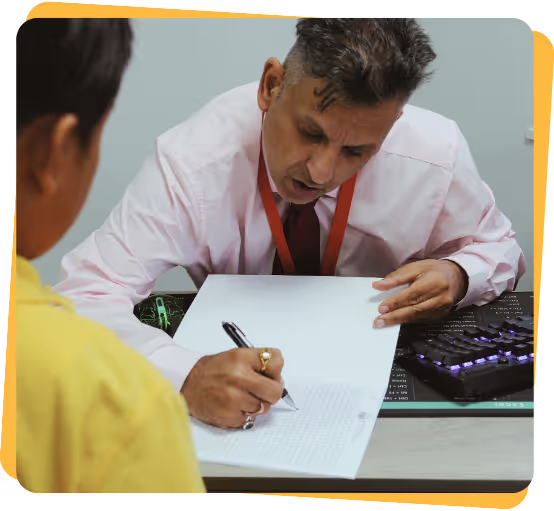
Mr Singh
Founder, Pass My GCSE
Mr Singh is the founder of Pass My GCSE, with over 30 years of teaching experience. Having overcome academic setbacks himself, he is passionate about ensuring no child struggles alone. His approach focuses on personalised support, strong foundations, and building confidence. He has helped students achieve outstanding results in 11+ and GCSE examinations
Loading related posts…
Ready to Transform Your Child's GCSE Results?
Join hundreds of Birmingham families who trust Pass My GCSE to deliver real, measurable results.