Loading page…
How to Pass GCSE Physics: A Complete Study Guide
Published on
To pass GCSE Physics, a student needs a grade 4 or above, and reliably getting there comes down to mastering five core topic areas, memorising key equations properly rather than just recognising them, and practising genuine past papers under timed conditions. Physics is often seen as one of the more intimidating sciences because of its mathematical content, but it is also one of the subjects with the highest proportion of top grades nationally, which shows that with the right approach, strong results are genuinely achievable.
Physics has a reputation for being the trickiest of the three sciences, mostly because of the maths woven through it, but the data tells a more encouraging story. In 2025, 45.4% of GCSE Physics entries achieved a grade 7 or above, the second highest proportion of any subject after Chemistry. This guide breaks down exactly what the exam involves, the topics worth mastering first, and the study techniques that turn Physics from an intimidating subject into a genuinely manageable one.
Key Takeaways
Grade 4 is a standard pass and grade 5 is a strong pass, the same benchmarks that apply across every GCSE subject.
Physics exams combine multiple choice, short answer and extended response questions, typically across 1 hour 45 minutes to 2 hours per paper.
Roughly 12 to 17% of students achieve a grade 9 in Physics each year, and 45.4% achieved a 7 or above in 2025, among the highest of any GCSE subject.
Understanding equations, not just memorising them, is what allows a student to apply them to unfamiliar exam questions.
Units matter. Dropping or mixing up units on a calculation is one of the most common, and most avoidable, ways marks are lost.
Understanding the GCSE Physics Exam
Physics exams typically combine three question styles, multiple choice, short answer questions, and longer extended response questions that ask for a more detailed explanation or calculation. Depending on the exam board, each paper generally runs between 1 hour 45 minutes and 2 hours, and marks are awarded across data analysis, theoretical understanding and practical based questions. Since GCSE Science includes a required set of practicals carried out during lessons, questions connected to these experiments make up a genuine share of the overall marks, so it is worth revising practical method and results alongside pure theory.
Knowing this structure in advance helps enormously with pacing. A paper split roughly evenly between short, quick questions and longer, multi-step ones needs a different time management approach than a paper weighted heavily towards extended answers.
How Well Do Students Actually Do in GCSE Physics?
Physics often gets a reputation as one of the hardest GCSEs, largely because of its mathematical content, but national results tell a more reassuring story. In 2025, Physics had the second highest proportion of top grades of any GCSE subject, with 45.4% of entries achieving a 7 or above, behind only Chemistry at 46.4%. Looking specifically at the very top grade, roughly 12 to 17% of students achieve a grade 9 in Physics in a typical year, a proportion that has generally been rising over recent years. Grade boundaries do vary by board and year, AQA has historically set its grade 9 boundary around 70%, while Edexcel has set it closer to 75%, which is a reminder that the exact percentage needed shifts depending on board and paper difficulty, not a fixed universal number.
Worth knowing: a subject's strong national results do not mean it feels easy day to day, they mean that with focused preparation, strong outcomes are genuinely achievable. Our guide on which GCSE subjects post the strongest results explains why national data like this should always be read carefully.
Five Core Topic Areas to Master
GCSE Physics content generally falls into five broad areas. Getting a genuinely solid grip on each of these first builds the foundation everything else sits on top of.
Forces and Motion
Built around Newton's Laws, this topic covers how forces interact in a given situation and their practical, real world applications. Weight and gravity are core concepts here too, including how weight is measured differently on Earth compared with in space.
Energy and Energy Resources
This covers the different forms of energy, kinetic, potential and thermal among them, and how energy converts between these forms. It also includes renewable and non renewable energy sources, along with concepts like efficiency and minimising energy waste.
Waves
This topic requires a clear understanding of transverse and longitudinal waves, how they behave differently across different materials, and the electromagnetic spectrum, including the properties and real world uses of each type of wave.
Electricity and Magnetism
Circuits are central here, from a simple series circuit through to more complex parallel arrangements. Magnetic fields also feature heavily, including how they are represented in diagrams and applied in the design of motors and generators.
Atomic Structure
This covers isotopes and radioactivity, including a clear explanation of radioactive decay and the specific risks associated with different types of radiation.
Study Techniques That Genuinely Work for Physics
Practise Active Learning, Not Passive Reading
Simply reading through notes is a weak way to build lasting understanding in Physics. Actively engaging with material, paraphrasing a concept in your own words, or explaining it to someone else, forces genuine understanding rather than surface level familiarity. Breaking the syllabus into small, weekly sections, rather than trying to cram several topics into a single session, keeps revision manageable and far more effective.
Understand Equations, Don't Just Memorise Them
Physics leans heavily on equations, and while memorising them is necessary, understanding what each one actually represents matters just as much. A useful technique is writing an equation on one side of a flashcard and its meaning or a worked example on the other, then testing recall regularly. Crucially, always practise applying equations to genuine exam style questions, and pay very close attention to units, mixing up metres and seconds, or kilograms and grams, is one of the most common and entirely avoidable ways marks are lost.
Use Mind Maps for Interconnected Concepts
Topics like atomic structure or the electromagnetic spectrum, where several related ideas need to connect together, work particularly well as mind maps. The visual structure makes it far easier to see how individual facts relate to the bigger picture, rather than treating each one in isolation.
Teach the Topic to Someone Else
Explaining a concept clearly to a friend, family member, or even an empty chair, is one of the fastest ways to spot gaps in understanding. If an explanation stumbles or feels vague at any point, that is exactly the area worth revisiting.
Keep a Dedicated Physics Notebook
Collecting every formula, diagram and practical note into one place makes revision far more efficient closer to exams, rather than hunting through scattered class notes for a single missing detail.
Why Past Papers Matter So Much in Physics
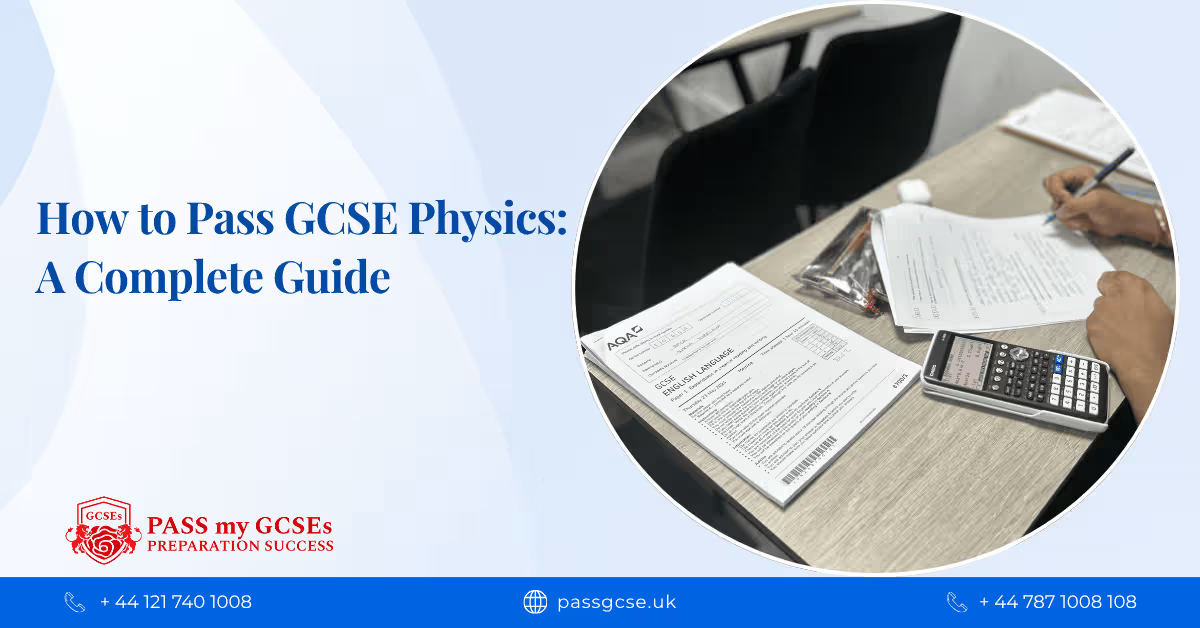
Working through genuine past papers is one of the most valuable things a Physics student can do. It builds familiarity with the exact type of questions likely to appear and how much time each section realistically needs.
Time yourself properly. Treat practice papers like the real exam, set a strict time limit and avoid moving on to other tasks partway through.
Mark your own work honestly. Use the official mark scheme once finished, since this reveals exactly where marks are being lost and which topics need more focused attention.
Repeat difficult question types. If a particular style of question, such as circuit calculations or wave diagrams, keeps causing trouble, deliberately seek out more examples of that exact type.
We always recommend working through authentic GCSE past papers, matched to the correct exam board, so every practice session reflects the real exam as closely as possible.
Staying Motivated Through a Demanding Subject
Physics can feel relentless without visible signs of progress, so building motivation into the revision process itself genuinely helps.
Set small, specific goals, such as completing one past paper or mastering one topic in a single sitting, rather than vague, open ended targets.
Celebrate real progress, whether that is finally understanding a previously confusing concept or completing a genuinely difficult past paper.
Revise with others where it helps, since discussing tricky concepts, working through equations together, and comparing revision strategies with classmates can make studying feel considerably less isolating.
Common Ways Marks Are Lost, and How to Avoid Them
Dropping or mixing up units. Always include the correct unit in a final answer, and double check that all values in a calculation use consistent units before working through it.
Skipping working out. Even when a final answer is correct, showing clear working protects marks if a small error creeps in along the way, and method marks are frequently available even without a fully correct answer.
Vague explanations in extended response questions. Longer questions expect a logical, step by step explanation using correct scientific terminology, not just a general, surface level answer.
Confusing required practicals. Since practical based questions make up a genuine share of the exam, it is worth revising the method, apparatus and likely sources of error for every required practical, not just the theory around it.
Turning This Guide Into Real Progress
Understanding the exam format, the core topics, and where marks are typically lost is the foundation. Turning that understanding into a genuine grade improvement is where the right structure and support make the real difference.
A Clear, Structured Revision Plan
Our GCSE revision courses guide students through Physics methodically, covering both content and the practical skills that make up a genuine share of the final grade.
Genuine Exam Practice
We always recommend working through real past papers, complete with official mark schemes, so students learn exactly how examiners award marks, not just how to reach a correct answer.
Realistic Mock Exams
Our GCSE mock exams recreate real timed conditions closely, helping students build genuine confidence and identify exactly which topics still need attention before results day.
Personal, One to One Guidance
Our GCSE Physics tutors work closely with each student, breaking down exactly which equations, topics or question styles are holding a grade back, and rebuilding understanding step by step. You can explore our full range of support at passgcse.uk.
Conclusion
GCSE Physics has a reputation for being difficult, largely because of its mathematical content, but the national data tells a genuinely encouraging story, it is one of the subjects with the highest proportion of top grades every year. Passing, and pushing beyond a pass towards a strong grade, comes down to mastering the five core topic areas, understanding equations rather than just memorising them, paying close attention to units and working, and practising with genuine past papers under real timed conditions. Combined with steady, active revision rather than passive rereading, Physics becomes a subject where consistent effort translates reliably into real progress.
Frequently Asked Questions
What grade do you need to pass GCSE Physics?
Grade 4 is the standard pass, and grade 5 is a strong pass, the same benchmarks that apply across every GCSE subject.
Is GCSE Physics harder than Biology or Chemistry?
Physics is often seen as more mathematically demanding, but national results show it consistently posts a high proportion of top grades, with 45.4% of entries achieving a 7 or above in 2025, second only to Chemistry.
What percentage do you need for a grade 9 in Physics?
This varies by exam board and year since boundaries are never fixed, but AQA has historically set its grade 9 boundary around 70%, and Edexcel closer to 75%. Roughly 12 to 17% of students achieve a grade 9 in a typical year.
Why do units matter so much in Physics exams?
Marks are commonly lost by dropping or mixing up units, such as confusing metres with centimetres. Always check that all values in a calculation use consistent units, and include the correct unit in every final answer.
What is the best way to revise for GCSE Physics?
A combination of active learning, understanding rather than memorising equations, mind maps for interconnected topics, and genuine timed past paper practice, marked honestly against the official scheme, consistently produces the strongest results.

Mr Singh
Founder, Pass My GCSE
Mr Singh is the founder of Pass My GCSE, with over 30 years of teaching experience. Having overcome academic setbacks himself, he is passionate about ensuring no child struggles alone. His approach focuses on personalised support, strong foundations, and building confidence. He has helped students achieve outstanding results in 11+ and GCSE examinations
Loading related posts…
Ready to Transform Your Child's GCSE Results?
Join hundreds of Birmingham families who trust Pass My GCSE to deliver real, measurable results.