Loading page…
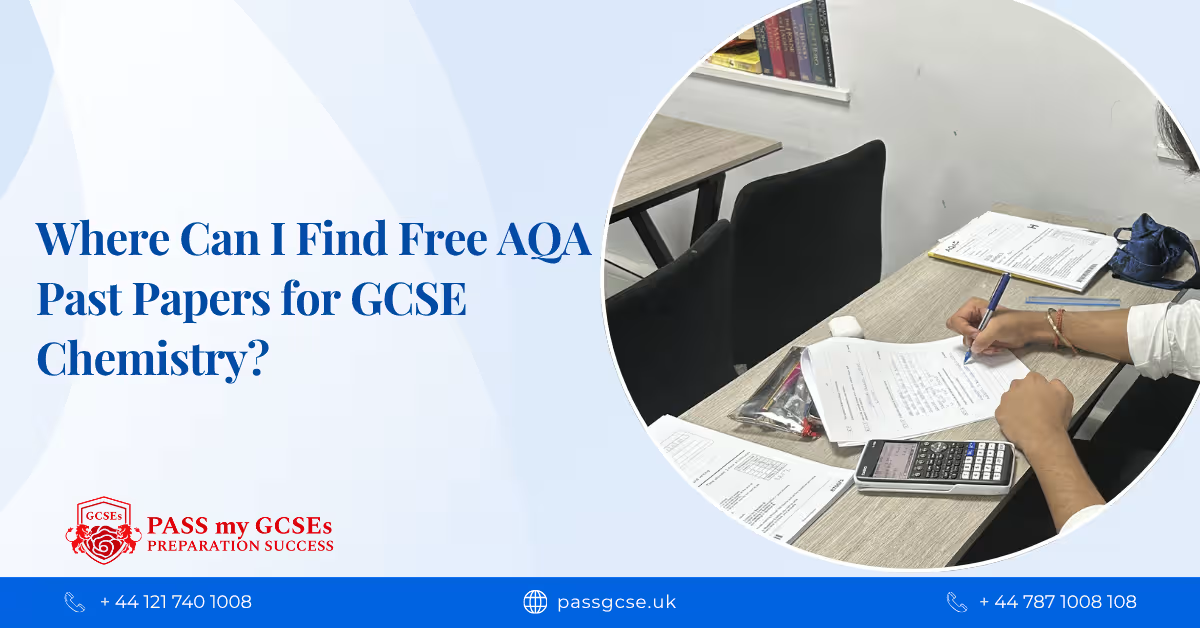
Where Can I Find Free AQA Past Papers for GCSE Chemistry?
Published on
The official source for free AQA GCSE Chemistry past papers is AQA's own website, where question papers, mark schemes, and examiner reports for specification 8462 are available to download at no cost, covering both Foundation and Higher tier. As with other AQA subjects, only a limited window of recent exam series tends to stay available before older papers are removed due to copyright restrictions, which is worth knowing before trying to build a genuinely thorough bank of practice material.
This guide covers exactly how GCSE Chemistry is structured across its two papers, what to download alongside each question paper, and how to use past paper practice in a way that actually improves a grade, rather than just working through papers for the sake of it.
Key Takeaways
GCSE Chemistry (8462) is assessed across two papers, each 1 hour 45 minutes long and worth 100 marks, giving a combined total of 200 marks split evenly between them.
Paper 1 covers topics 1 to 5 and Paper 2 covers topics 6 to 10, and both papers test the same three assessment objectives: recall, application, and analysis of practical and experimental data.
At least 20% of all marks across both papers come from mathematical skills, such as moles calculations, percentage yield, and concentration, so calculation practice deserves dedicated revision time.
There are 8 required practicals on the specification, and practical-skills questions make up at least 15% of the overall marks, appearing across both papers rather than in a single dedicated section.
Understanding the Structure of GCSE Chemistry
AQA GCSE Chemistry, specification 8462, is a linear qualification structured around ten topics and assessed by two written papers at the end of Year 11, with no coursework involved. Each paper is 1 hour 45 minutes long and worth 100 marks, giving a combined total of 200 marks, and both papers are equally weighted at 50% of the final grade each.
Paper | Length | Marks | Topics Covered |
Paper 1 | 1 hour 45 minutes | 100 | Topics 1 to 5 |
Paper 2 | 1 hour 45 minutes | 100 | Topics 6 to 10 |
Both papers test the same three assessment objectives: recall of chemistry content, application of that knowledge to unfamiliar contexts, and analysis of practical and experimental data. Each paper mixes multiple choice, short structured answers, longer extended response questions worth up to six marks, and calculation-heavy questions, so no single question style dominates either paper.
It is worth being clear on which qualification is actually being sat, since AQA also offers GCSE Chemistry as part of Combined Science: Trilogy, specification 8464, which covers similar content in less depth across six shorter papers shared between Biology, Chemistry, and Physics. This guide focuses specifically on separate Chemistry, sat as part of Triple Science under code 8462.
Where to Find AQA GCSE Chemistry Past Papers for Free
AQA makes past papers, mark schemes, and examiner reports for specification 8462 available directly through their own website, organised by paper, tier, and exam series. As with other AQA subjects, only a limited number of recent series tend to remain accessible before older papers are withdrawn due to copyright restrictions, so the most recent one or two years are generally the most reliably available directly from AQA at any given time.
For a wider, properly organised collection that saves time tracking down individual series and confirming they match the correct tier, our GCSE past papers resource brings together genuine exam board papers across a range of subjects, with our dedicated GCSE Chemistry past papers page focused specifically on AQA Chemistry, already organised by tier so there is no second guessing involved before you start practising.
What to Download Alongside the Question Paper
A question paper alone only tells part of the story for Chemistry. A few additional resources make past paper practice genuinely more effective:
The mark scheme. Chemistry mark schemes are specific about which marks are for method and which are for a correct final answer, particularly in calculation questions, so understanding this changes how working is shown and checked.
Examiner reports. These highlight the most common mistakes made each series, which for GCSE Chemistry frequently includes unit conversion errors, unbalanced symbol equations, and vague explanations in extended response questions.
The required practicals list. Since practical-skills questions can appear on either paper, reviewing which of the 8 required practicals a paper is drawing on helps target revision towards the method, apparatus, and likely sources of error for each one.
Why Maths and Required Practicals Deserve Dedicated Attention
A genuinely significant share of GCSE Chemistry, at least 20% of all marks across both papers, comes directly from mathematical skills such as moles calculations, percentage yield, and concentration. This means a meaningful chunk of marks lost in Chemistry often has very little to do with not understanding the underlying science, and everything to do with a small, avoidable slip in the maths itself, whether that is an incorrect unit conversion or a rushed piece of arithmetic. Practising these calculation types repeatedly, until the method feels automatic, is one of the most reliable ways to recover marks that have nothing to do with chemistry knowledge at all.
Required practicals deserve equally dedicated attention. There are 8 required practicals across the specification, and practical-skills questions make up at least 15% of the overall marks, appearing on either paper rather than being confined to one section. Students are not expected to carry out an experiment in the exam hall, but they are expected to describe the method, identify variables, interpret results, and evaluate the technique as though they had done it themselves. AQA tends to return to a fairly consistent set of question styles here year after year, which means practising with real past paper questions on required practicals builds genuinely transferable pattern recognition, not just knowledge of one specific experiment.
How to Use Past Papers Effectively for GCSE Chemistry
Practise both papers evenly. Since Paper 1 and Paper 2 cover different topics rather than repeating the same content, neglecting one in favour of the other leaves a genuine gap in preparation.
Always show full working on calculation questions. Method marks are frequently available even when a final answer is wrong, but only if the working leading to it is clearly shown and legible.
Mark your work against the actual mark scheme, not just for a correct final number. Understanding exactly which marks were for method and which were for accuracy reveals precisely where technique, not understanding, is costing marks.
Revise required practicals using real past paper questions. Since AQA reuses a fairly consistent set of question styles for practicals, working through several examples across different papers builds genuine familiarity with what is actually being asked.
Getting More From Your Chemistry Revision
Working through genuine past papers is one of the most effective things a GCSE Chemistry student can do, but pulling together papers across both tiers, confirming they match the current specification, and understanding exactly how each mark scheme awards credit for calculations and practical questions takes real time. Our GCSE Chemistry past papers page brings this together in one place, so revision time goes towards genuine practice rather than second guessing whether a resource is trustworthy or correctly matched.
For students who keep losing marks on the same calculation types or required practicals no matter how many papers are attempted, working with one of our GCSE Chemistry tutors can identify exactly why a particular topic or question style keeps causing trouble and correct it directly. Our GCSE mock exams also give students the chance to sit a full, timed paper under genuine exam conditions with detailed, examiner style feedback, which is difficult to replicate through self marked practice alone.
Conclusion
GCSE Chemistry rewards students who treat maths and required practicals as seriously as core content knowledge, and genuine past papers are one of the most effective ways to build all three together. AQA's own website remains the best starting point for free question papers, mark schemes, and examiner reports for specification 8462, though its limited window of available series means a wider, properly organised collection is often worth having alongside it. Used consistently, with full working shown on calculations, required practicals revised through real exam questions, and honest marking against the actual mark scheme, past paper practice becomes one of the most reliable ways to turn strong understanding into a strong final grade.
Frequently Asked Questions
How many papers make up GCSE Chemistry, and how are they structured?
GCSE Chemistry (8462) is made up of two papers, each 1 hour 45 minutes long and worth 100 marks, giving a combined total of 200 marks. Paper 1 covers topics 1 to 5 and Paper 2 covers topics 6 to 10, and both papers are equally weighted at 50% each.
Are AQA GCSE Chemistry past papers free to download?
Yes. AQA makes past papers, mark schemes, and examiner reports for specification 8462 available for free, though as with other AQA subjects, only a limited number of recent exam series typically remain available before older papers are withdrawn due to copyright restrictions.
How much of GCSE Chemistry is actually maths?
At least 20% of the total marks across both papers come from mathematical skills, including moles calculations, percentage yield, and concentration. This makes calculation practice a genuinely significant part of Chemistry revision, not a minor add-on to the science content.
How many required practicals are there in GCSE Chemistry, and how much are they worth?
There are 8 required practicals on the AQA GCSE Chemistry specification, and practical-skills questions make up at least 15% of the overall marks, appearing across both papers rather than in one dedicated section.
What is the difference between GCSE Chemistry (8462) and Combined Science Chemistry (8464)?
GCSE Chemistry (8462) is the separate Triple Science qualification, assessed across two dedicated papers. Combined Science: Trilogy (8464) covers similar content in less depth, spread across six shorter papers shared between Biology, Chemistry, and Physics, and results in two combined GCSE grades rather than one standalone Chemistry grade.

Mr Singh
Founder, Pass My GCSE
Mr Singh is the founder of Pass My GCSE, with over 30 years of teaching experience. Having overcome academic setbacks himself, he is passionate about ensuring no child struggles alone. His approach focuses on personalised support, strong foundations, and building confidence. He has helped students achieve outstanding results in 11+ and GCSE examinations
Loading related posts…
Ready to Transform Your Child's GCSE Results?
Join hundreds of Birmingham families who trust Pass My GCSE to deliver real, measurable results.