Loading page…
Where Can I Find Free AQA Past Papers for GCSE Spanish?
Published on
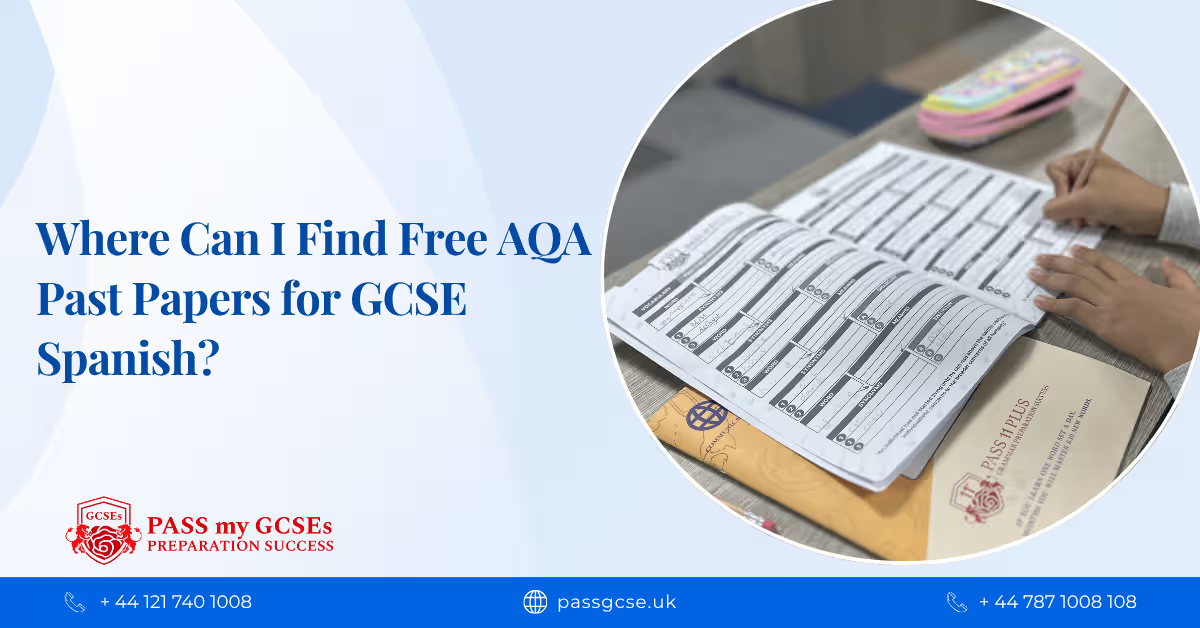
The official source for free AQA GCSE Spanish past papers is AQA's own website, where question papers, mark schemes, listening test audio, and examiner reports for specification 8698 are available to download at no cost, covering both Foundation and Higher tier. As with other AQA subjects, only a limited window of recent exam series tends to stay available before older papers are withdrawn due to copyright restrictions, which is worth planning around if you are hoping to build a genuinely thorough bank of practice material.
This guide covers exactly how GCSE Spanish is structured across its four papers, what to download alongside each question paper, and how to actually turn past paper practice into real improvement rather than simply ticking a box.
Key Takeaways
GCSE Spanish (8698) is assessed across four equally weighted skills, Listening, Speaking, Reading, and Writing, each contributing the same share to the final grade.
It is a linear qualification, and students must sit all four papers at the same tier, either Foundation, covering grades 1 to 5, or Higher, covering grades 4 to 9.
Speaking is worth a full quarter of the final grade, so past papers alone are not enough, spoken practice needs dedicated attention alongside written revision.
Listening papers need the accompanying audio, not just the transcript, and grade 9 performance typically requires roughly 85 to 95% of scaled marks across all four components.
Understanding the Structure of GCSE Spanish
GCSE Spanish, specification 8698, is built around four separate skills that are each weighted equally, meaning Listening, Speaking, Reading, and Writing each contribute the same proportion to the final grade. This equal weighting is worth remembering, since it means a strong performance in Writing cannot fully compensate for a weak Speaking paper, and every skill genuinely deserves proportionate revision time.
Because it is a linear qualification, all four papers are sat at the end of the course, in the same exam series, rather than being spread across separate assessment windows. Students must also sit every paper at the same tier, either Foundation, which covers grades 1 to 5, or Higher, which covers grades 4 to 9, so it is not possible to mix tiers across different skills. If you are unsure which tier is the right fit, that is a conversation worth having with a teacher or tutor before committing significant revision time to one tier over the other.
Paper | Skill | Weighting |
Paper 1 | Listening | 25% |
Paper 2 | Speaking | 25% |
Paper 3 | Reading | 25% |
Paper 4 | Writing | 25% |
Grade boundaries are published on results day and vary slightly year to year depending on overall paper difficulty, but as a general guide, grade 9 performance in AQA Spanish typically requires roughly 85 to 95% of scaled marks across all four components combined.
Where to Find AQA GCSE Spanish Past Papers for Free
AQA makes past papers, mark schemes, and examiner reports for specification 8698 available directly through their own website, organised by paper, tier, and exam series. As with other AQA subjects, only a limited number of recent series tend to remain accessible before older papers are withdrawn due to copyright restrictions, so the most recent one or two years are generally the most reliably available directly from AQA at any given time.
For a wider, properly organised collection that saves time tracking down individual series and confirming they match the correct tier, our GCSE past papers resource brings together genuine exam board papers across a range of subjects, with our dedicated GCSE Spanish past papers page focused specifically on AQA Spanish, already organised by tier so there is no second guessing involved before you start practising.
What to Download Alongside the Question Paper
A question paper alone only tells part of the story for a language subject. A few additional resources make Spanish past paper practice genuinely more effective:
The mark scheme. Language mark schemes reward accuracy and range of vocabulary and grammar, not simply a broadly understandable answer, so knowing exactly what earns marks changes how written responses are approached.
Listening test audio. Reading a listening transcript alone defeats the purpose of the paper. The recordings themselves, delivered by native speakers at natural pace, are essential for building genuine exam-day listening skills, not just word recognition on a page.
Examiner reports. These highlight the specific errors students make most often each series, which for GCSE Spanish frequently includes verb tense confusion, gender agreement, and overly literal translation from English sentence structure.
Why Speaking Deserves Just as Much Practice as Written Papers
It is easy for Speaking to become the most neglected of the four skills simply because it feels less straightforward to self-practise than a written paper. But because it carries a full 25% of the final grade, treating it as an afterthought puts a genuinely significant share of marks at risk. Past speaking assessment materials and role play or photo card themes are worth rehearsing out loud regularly, ideally with feedback from a teacher, tutor, or even a fellow student, since spoken fluency and confidence build through actual speaking practice in a way that silent, written revision simply cannot replicate.
How to Use Past Papers Effectively for GCSE Spanish
Practise every skill, not just the ones that feel comfortable. With all four papers weighted equally, neglecting Speaking or Listening in favour of Writing revision leaves a full quarter of the grade underprepared.
Mark written answers against the actual mark scheme, not just for overall sense. A response that is broadly understandable but contains repeated grammatical errors or narrow vocabulary will not score as highly as it might feel like it deserves.
Always use the real listening audio. Practising with a transcript alone builds reading skills, not listening skills, and the exam is testing genuine spoken comprehension at natural pace.
Track recurring errors across multiple papers. If gender agreement or a particular tense keeps appearing as a mistake across several practice attempts, that specific pattern is exactly where focused revision time should go next.
Getting More From Your Spanish Revision
Working through genuine past papers is one of the most effective things a GCSE Spanish student can do, but pulling together papers across every skill, confirming the correct tier, and knowing precisely what each mark scheme is rewarding takes real time. Our GCSE Spanish past papers page brings this together in one place, alongside guidance on exactly how marks are awarded across all four skills, so revision time goes towards genuine practice rather than second guessing whether a resource is trustworthy or correctly matched to the current specification.
For students who find Speaking or a specific grammar area, such as tense accuracy or gender agreement, consistently holding their overall grade back, our GCSE languages tuition provides focused, one to one support that identifies exactly where understanding is breaking down and builds genuine spoken confidence alongside written accuracy, rather than leaving Speaking practice to chance in the final weeks before exams.
Conclusion
GCSE Spanish rewards genuinely balanced preparation across all four equally weighted skills, Listening, Speaking, Reading, and Writing, rather than concentrated effort in whichever paper feels most comfortable. Genuine past papers, mark schemes, listening audio, and examiner reports for specification 8698 are freely available directly from AQA, though only a limited recent window tends to stay accessible at any one time. Used consistently, alongside real spoken practice for Speaking and honest marking against the actual mark scheme, past papers become one of the most effective tools available for building a strong, well rounded GCSE Spanish grade.
Frequently Asked Questions
How many papers make up GCSE Spanish, and how are they weighted?
GCSE Spanish (8698) is made up of four papers, Listening, Speaking, Reading, and Writing, each weighted equally at 25% of the final grade. This means every skill genuinely needs proportionate revision time, since strong performance in one paper cannot fully compensate for a weak one elsewhere.
What is the difference between Foundation and Higher tier in GCSE Spanish?
Foundation tier covers grades 1 to 5, while Higher tier covers grades 4 to 9. Students must sit all four papers at the same tier, so it is not possible to take some skills at Foundation and others at Higher.
Are AQA GCSE Spanish past papers free to download?
Yes. AQA makes past papers, mark schemes, listening test audio, and examiner reports for specification 8698 available for free, though as with other AQA subjects, only a limited number of recent exam series typically remain available before older papers are withdrawn due to copyright restrictions.
Why do I need the listening audio and not just the transcript?
The listening paper tests genuine spoken comprehension at natural pace, delivered by native speakers. Practising with a transcript alone builds reading skills rather than listening skills, and will not prepare you accurately for how the real exam actually sounds.
What score do I need for a grade 9 in GCSE Spanish?
Grade boundaries change slightly each year depending on overall paper difficulty and are published on results day, but as a general guide, grade 9 performance typically requires roughly 85 to 95% of scaled marks combined across all four components.

Mr Singh
Founder, Pass My GCSE
Mr Singh is the founder of Pass My GCSE, with over 30 years of teaching experience. Having overcome academic setbacks himself, he is passionate about ensuring no child struggles alone. His approach focuses on personalised support, strong foundations, and building confidence. He has helped students achieve outstanding results in 11+ and GCSE examinations
Loading related posts…
Ready to Transform Your Child's GCSE Results?
Join hundreds of Birmingham families who trust Pass My GCSE to deliver real, measurable results.