Loading page…
Where Can I Find Free AQA Past Papers for GCSE Maths?
Published on
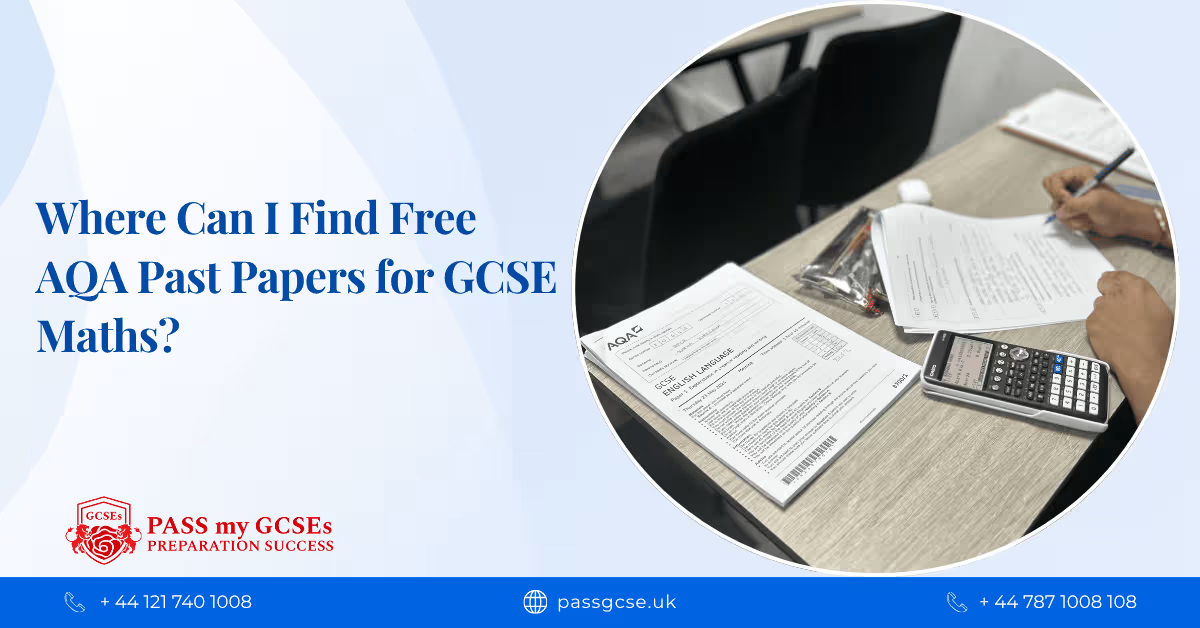
The official source for free AQA GCSE Maths past papers is AQA's own website, through their past papers and mark schemes finder, where question papers, mark schemes, and examiner reports are available to download at no cost for both Foundation and Higher tier. The one thing worth knowing before you go looking is that AQA only keeps papers available on their site for around three years, after which older series are removed due to copyright restrictions, which is why many students end up needing more than one source to build up a genuinely thorough bank of practice material.
This guide covers exactly where to find AQA GCSE Maths past papers for free, what to actually download alongside the question papers themselves, how the exam is structured, and how to use everything you find in a way that genuinely improves your grade, rather than just ticking a box marked "did some past papers."
Key Takeaways
AQA's official website is the best and most reliable source for free GCSE Maths past papers, mark schemes, and examiner reports, though only around three years of papers remain available at any one time due to copyright rules.
GCSE Maths (8300) is assessed across three papers, one non-calculator and two calculator, each 90 minutes long and worth 80 marks, for a total of 240 marks across the whole qualification.
The mark scheme is just as important as the question paper itself, since AQA maths mark schemes clearly show which marks are for method and which are for a correct final answer, which changes how partial credit is understood.
Foundation tier covers grades 1 to 5, and Higher tier covers grades 4 to 9, so downloading the correct tier matters as much as downloading the correct exam board.
The Official Source: AQA's Own Website
The most reliable place to find genuine, unaltered AQA GCSE Maths past papers is directly through AQA's own past papers and mark schemes finder. Selecting GCSE, then Mathematics (8300), brings up every available exam series with the question paper, mark scheme, and often an examiner report attached to each one.
The one limitation worth planning around is that AQA only keeps papers on their website for roughly three years before removing them due to copyright restrictions. This means the most recent series are always available, but if you are looking for papers from several years back to build a larger practice bank, or you simply want every paper already organised by tier and topic in one place, that is exactly where our own GCSE past papers collection is genuinely useful, bringing together papers across every subject and exam board, with our dedicated GCSE Maths past papers page focusing specifically on AQA Maths across multiple years, without needing to track down older series individually.
Where to Find Older or Additional Papers in One Place
Because AQA's own archive only stretches back a few years, students often end up hunting across several different websites trying to piece together a decent bank of older papers, with no easy way to check whether a given paper genuinely matches the current specification, 8300, or has the correct tier clearly labelled. Older specifications used different question styles and grading, and practising the wrong tier wastes valuable revision time on content that will not actually appear in your exam.
This is exactly the problem our GCSE Maths past papers page solves. Every paper is checked against the current specification and clearly organised by exam board and tier, Foundation or Higher, so there is no guesswork involved in confirming a paper is genuinely relevant before spending time on it.
Download AQA GCSE Maths Past Papers
Looking for free AQA GCSE Maths past papers? You can find and download AQA Maths past papers, mark schemes and other useful exam resources on Pass GCSE.
Access the AQA GCSE Maths past papers here: Download AQA GCSE Maths Past Papers
Understanding the GCSE Maths Exam Structure
Knowing exactly how the exam is structured makes past paper practice far more purposeful, since it shapes how you should be timing yourself and where the marks are actually concentrated.
Paper | Type | Length | Marks |
Paper 1 | Non-calculator | 90 minutes | 80 |
Paper 2 | Calculator | 90 minutes | 80 |
Paper 3 | Calculator | 90 minutes | 80 |
Each paper is worth exactly a third of the final grade, so there is no single paper that matters more than the others, which is worth remembering if one paper goes badly. Foundation tier covers grades 1 to 5, while Higher tier covers grades 4 to 9, with some overlapping content around grades 4 and 5 that often causes genuine debate over which tier a student should sit. If you are unsure which tier applies to you, your school or tutor is the right person to confirm this before you start practising, since revising the wrong tier wastes time on content that will not appear in your actual exam.
Why the Mark Scheme Matters as Much as the Paper Itself
Downloading the question paper alone only gets you halfway there. AQA Maths mark schemes are detailed and specific, and understanding how they work changes how you interpret your own practice attempts.
Marks in AQA Maths papers generally fall into a few categories. Method marks, usually labelled M, are awarded for using a correct approach, even if the final numerical answer ends up wrong due to a later arithmetic slip. Accuracy marks, usually labelled A, depend on that method mark already being awarded and reward a correct final answer reached through valid working. This means a student who shows clear working but makes a small calculation error can still pick up a meaningful share of the marks, while a student who writes down a correct final answer with no working risks losing marks entirely, since there is no way to confirm the method used was valid.
This is also why command words matter in Maths just as much as in any other subject. A question that says "show that" expects to see full working leading to the given answer, not just the answer itself, and a question that says "give a reason" expects an actual written sentence, not a number alone. These are small details, but they are exactly the kind of thing that quietly costs marks even when a student's underlying maths is genuinely strong.
How to Actually Use Past Papers Effectively
Simply completing past papers is not, on its own, enough to move a grade. How they are used afterwards matters just as much as attempting them in the first place.
Time yourself properly. Treat every practice paper like the real thing, with a strict 90 minute limit and no pausing partway through, so pacing under pressure becomes familiar rather than a surprise on exam day.
Mark honestly against the actual mark scheme. Check not just whether the final answer was correct, but whether the correct method marks would genuinely have been awarded based on the working shown.
Identify patterns in what goes wrong. If the same topic or question type causes problems across several papers, that is a clear signal for where focused revision time should go next, rather than repeating full papers indefinitely.
Revisit the exact same question types again later. Once a weak area has been revised properly, come back a week or two later with fresh questions on that same topic to confirm the improvement has genuinely stuck.
Getting More From Your Past Paper Practice
Free past papers are an excellent starting point, but pulling together genuine papers, checking they match the current specification and correct tier, and understanding exactly what each mark scheme is rewarding takes real time, time that could otherwise go into actual revision. This is exactly the gap our GCSE Maths past papers resource is built to close, bringing together genuine AQA Maths papers matched precisely to the correct tier, alongside guidance on exactly how each mark scheme awards credit, so practice time is spent productively rather than second guessing whether a resource is trustworthy.
If past paper practice keeps revealing the same recurring weak spots no matter how many papers are attempted, that is often a sign worth acting on directly. Working with one of our GCSE Maths tutors can identify precisely why a particular topic or question style keeps causing trouble and correct it directly, rather than repeating the same practice approach that has not been moving the needle. Our GCSE mock exams also give students the chance to sit a full, timed paper under genuine exam conditions with detailed, examiner style feedback, which is difficult to replicate through self marked practice alone. And for a properly structured route through the entire specification rather than scattered topic practice, our GCSE revision courses are designed by examiners around exactly the areas that most reliably move a Maths grade.
GCSE MATHS TUITION
Stuck on the Same Maths Questions?
Get expert one-to-one maths tuition built around your exam board, your tier and the papers you are sitting.
Conclusion
Genuine AQA GCSE Maths past papers are readily available for free, whether that is a recent series from AQA directly or a wider range of years through our own GCSE Maths past papers collection, already organised by tier so there is no guesswork involved. Whichever source is used, the real value comes from what happens after the paper is completed, timing it properly, marking it honestly against the actual mark scheme, and using the patterns that emerge to direct exactly where revision time goes next. Used this way, past papers stop being a box ticking exercise and become one of the most genuinely effective tools available for improving a Maths grade.
Frequently Asked Questions
Are AQA GCSE Maths past papers really free?
Yes. AQA makes past papers, mark schemes, and examiner reports for GCSE Maths (8300) available to download for free directly through their past papers and mark schemes finder, though only around three years of past series remain available at any given time due to copyright restrictions.
Why can't I find older AQA Maths past papers on the AQA website?
AQA removes older exam series from their website after roughly three years due to copyright restrictions. For papers beyond that window, our GCSE Maths past papers collection brings together AQA Maths papers across a wider range of years, already checked against the current specification and organised by tier.
What is the difference between Foundation and Higher tier GCSE Maths?
Foundation tier covers grades 1 to 5, while Higher tier covers grades 4 to 9, with some shared content around the grade 4 and 5 boundary. Choosing the correct tier is essential before practising past papers, since Foundation and Higher papers contain different content and question difficulty.
How many papers make up GCSE Maths, and how are they marked?
GCSE Maths (8300) is made up of three papers, one non-calculator and two calculator, each 90 minutes long and worth 80 marks, giving a total of 240 marks across the whole qualification. Each paper carries equal weighting towards the final grade.
Do I need the mark scheme as well as the past paper itself?
Yes, and it matters more than many students realise. AQA Maths mark schemes show exactly which marks are for method and which are for a correct final answer, which reveals how much credit is available even when a final answer is wrong, and highlights command words like "show that" or "give a reason" that require specific working or explanation to earn full marks.

Mr Singh
Founder, Pass My GCSE
Mr Singh is the founder of Pass My GCSE, with over 30 years of teaching experience. Having overcome academic setbacks himself, he is passionate about ensuring no child struggles alone. His approach focuses on personalised support, strong foundations, and building confidence. He has helped students achieve outstanding results in 11+ and GCSE examinations
Loading related posts…
Ready to Transform Your Child's GCSE Results?
Join hundreds of Birmingham families who trust Pass My GCSE to deliver real, measurable results.