Loading page…
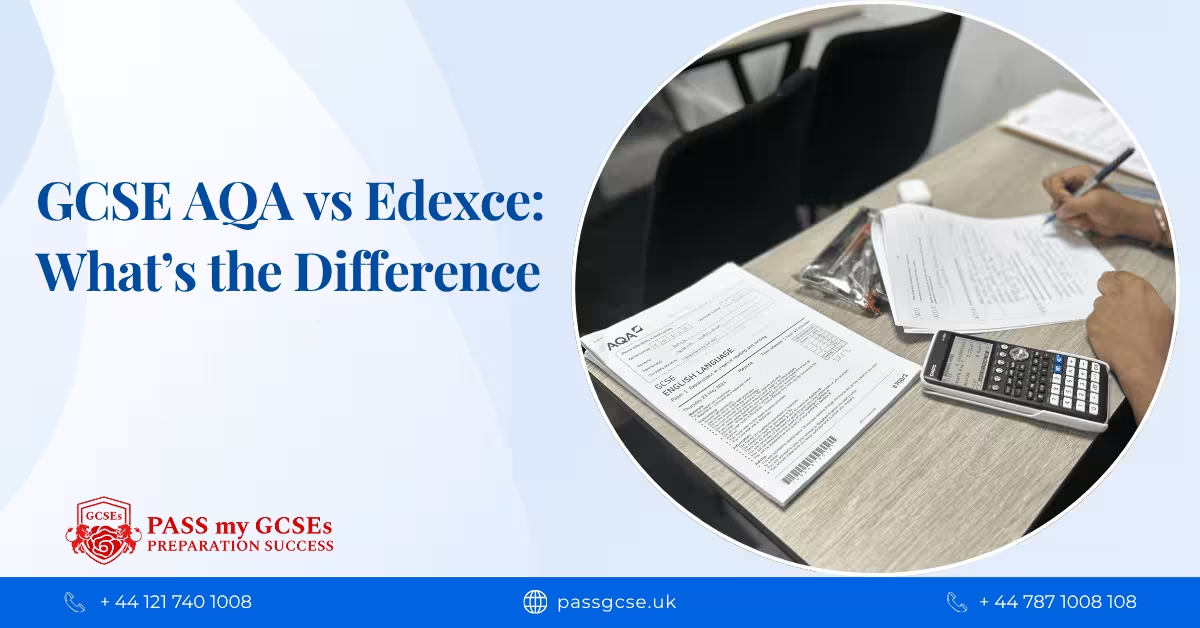
GCSE AQA vs Edexce: What’s the Difference
Published on
AQA and Edexcel are two of the biggest names in GCSE exams, and if your child is studying with one of them, you have probably wondered what actually makes them different. The truth is, both boards cover very similar content, but the way they test that content can feel quite different once you look closely.
In this guide, we will compare AQA and Edexcel in simple terms, looking at how their papers are structured, how each subject is approached, and what this actually means for revision. No confusing jargon, just a clear, honest comparison.
Key Takeaways
AQA and Edexcel are both regulated by Ofqual and follow the same national curriculum.
The core content is very similar, the real differences lie in paper structure and question style.
AQA is often described as having clear, detailed mark schemes and balanced papers.
Edexcel papers are often described as clearly structured, with questions that build up gradually.
Whichever board your child studies with, revising using the correct board's past papers matters far more than which board is "better."
Who Are AQA and Edexcel?
Both AQA and Edexcel are major exam boards used widely across schools in England.
AQA, short for the Assessment and Qualifications Alliance, is one of the largest exam boards in the country. It is especially popular for English, Science and Humanities subjects, and is well known for offering clear, detailed guidance for both teachers and students.
Edexcel is run by Pearson, a large global education company. As well as standard GCSEs, Edexcel also offers International GCSE qualifications, and is frequently chosen for subjects like Maths and Business Studies.
Both boards are regulated by Ofqual, meaning they must follow the same national curriculum rules and use the same 9 to 1 grading scale. So no matter which board a student studies with, the underlying standard being tested is the same.
How Do AQA and Edexcel Actually Differ?
Since both boards follow the same curriculum, the real differences come down to how each one structures its papers and phrases its questions, rather than what topics are covered.
AQA
Known for clear, detailed mark schemes
Papers often feel evenly balanced across sections
Popular choice for English, Science and Humanities
Strong focus on structured, step by step written answers
Edexcel
Papers often build up gradually, moving from simpler to harder questions
Also offers International GCSE options
Popular choice for Maths and Business Studies
Known for a clean, predictable paper layout
Neither board is harder or easier overall, they simply test the same knowledge in slightly different ways. This is exactly why matching revision to the correct board matters so much, since a student well prepared for one board's style might still feel caught off guard by the other's format.
Subject by Subject, Where the Differences Show Up Most
English
Both boards test reading, writing and understanding of texts, but the exact set texts, poetry anthologies and question wording can differ. This is one of the areas where checking your specific board matters most, since studying the wrong set text would waste valuable revision time.
Maths
Both boards cover the same Foundation and Higher tier content, but Edexcel papers are often noted for their gradually building question style, while AQA papers tend to mix question difficulty more evenly throughout each paper. Getting used to your own board's pacing and style through practice makes a real difference here.
Science
Core Biology, Chemistry and Physics content is very similar across both boards, but how questions are worded, and how much emphasis is placed on practical or data based questions, can vary. Reviewing your board's specification helps clarify exactly what to expect.
Humanities and Other Subjects
Subjects like History, Geography and Business Studies can vary more noticeably between boards, sometimes covering different topic options or case studies entirely. It is always worth checking the specific syllabus your school has chosen, rather than assuming it matches a general overview.
Does It Matter Which Board My Child Is Studying With?
In terms of overall difficulty or how universities and employers view results, no single board is seen as better or worse than another. What matters far more is that your child revises using material that actually matches their board.
Simple rule to remember: the exam board itself does not determine how well a student does, how well their revision matches that board does. If your child is unsure which board they are studying with for a subject, the quickest way to check is simply asking their teacher, or looking at the front cover of any past papers or classroom materials they already have.
How to Revise Effectively for Either Board
Always Use the Correct Board's Past Papers
This is one of the most important habits a student can build. Practising with the wrong board's past papers can build the wrong exam technique entirely, since question wording and paper structure genuinely differ between AQA and Edexcel. Our GCSE past papers are organised clearly by exam board, so students can be confident they are always practising with content that matches their real exam.
Follow a Structured Plan Built Around the Right Specification
Rather than revising from generic notes, following a plan that matches the correct board's specification keeps study time focused on what will actually be tested. Our GCSE revision courses are designed around real exam board specifications, helping students cover exactly what matters, without wasting time on the wrong content.
Practise Under Timed, Board Specific Conditions
Getting comfortable with a board's exact paper structure and timing is just as important as knowing the content. Our GCSE mock exams are built to reflect the real format of each major exam board, giving students the chance to build genuine confidence with the pacing and style they will actually face.
Get Personal Guidance Matched to the Right Board
Sometimes the fastest way to improve is having someone explain exactly what a specific board expects, and where students commonly lose marks. Our GCSE tutors tailor every lesson to the student's exact exam board, whether that is AQA, Edexcel, or another major board, so revision always feels directly relevant.
GCSE TUITION
Ready to Help Your Child Succeed in Their GCSEs?
Join hundreds of families who trust Pass GCSE for expert tuition, proven results, and a clear path to exam success.
The Bottom Line on AQA vs Edexcel
Choosing between AQA and Edexcel is rarely something students get to decide themselves, since schools select the board for each subject. What really matters is not which board a student happens to be studying with, but making sure their revision, past papers and practice are properly matched to it. Once that is sorted, both boards offer a completely fair and equal path to strong GCSE results.
Want revision that is matched exactly to your child's exam board, whether that is AQA, Edexcel, or another major board? Our experienced tutors can build a focused plan around their exact syllabus.
Frequently Asked Questions
Is AQA harder than Edexcel, or the other way around?
Neither board is considered harder overall. Both are regulated by Ofqual and follow the same national curriculum, though their paper styles and question wording differ.
Do universities prefer AQA or Edexcel results?
No, universities and employers do not favour one board over another. What matters is the grade achieved, not which exam board it came from.
Can a student choose their own exam board?
Usually not. Schools select the exam board for each subject, and students study under whichever board their school has chosen.
How can I find out if my child is studying AQA or Edexcel?
The simplest way is to ask their subject teacher, or check the front cover of any past papers or classroom materials, since the board name is usually printed clearly there.
Does it matter if I revise using the wrong board's past papers?
Yes, it can. Question wording and paper structure differ between boards, so practising with the wrong board's papers may build the wrong exam technique for the real thing.

Mr Singh
Founder, Pass My GCSE
Mr Singh is the founder of Pass My GCSE, with over 30 years of teaching experience. Having overcome academic setbacks himself, he is passionate about ensuring no child struggles alone. His approach focuses on personalised support, strong foundations, and building confidence. He has helped students achieve outstanding results in 11+ and GCSE examinations
Loading related posts…
Ready to Transform Your Child's GCSE Results?
Join hundreds of Birmingham families who trust Pass My GCSE to deliver real, measurable results.