Loading page…
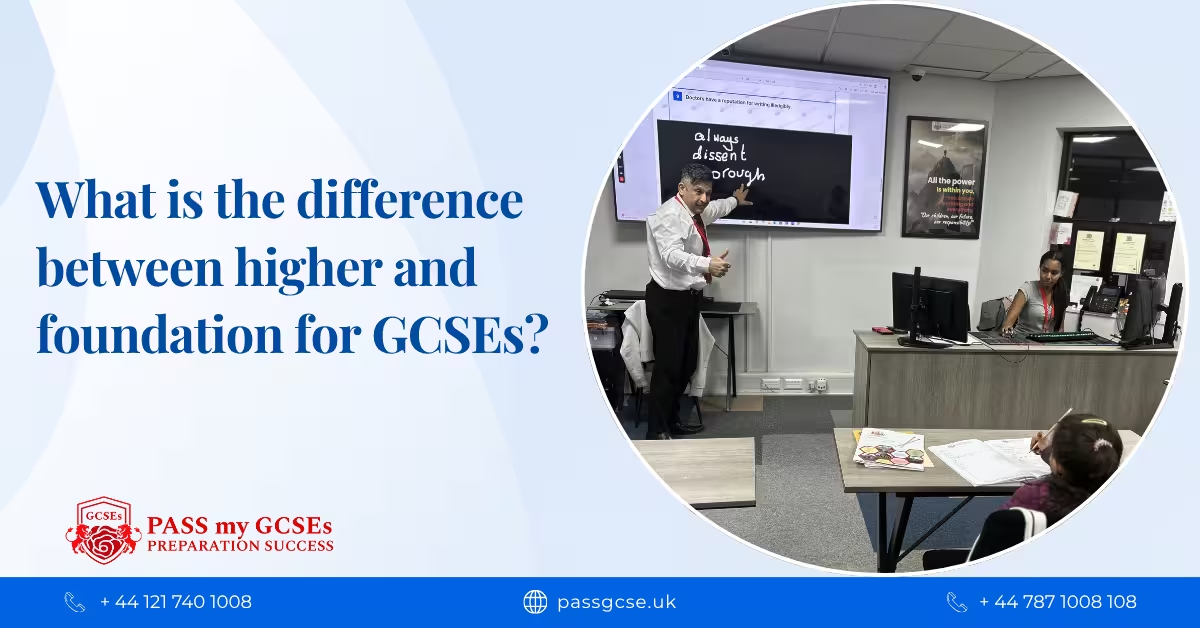
What is the difference between higher and foundation for GCSEs?
Published on
If you have heard your teacher mention 'Foundation tier' or 'Higher tier' and felt a bit lost, you are definitely not the only one. It is one of those GCSE terms that gets thrown around a lot, but rarely gets explained properly. Yet choosing the right tier can genuinely shape which grades you are even able to get.
In this guide, we will break down exactly what Foundation and Higher tier mean, which subjects use them, what grades each tier allows, and how to work out which one is right for you. All explained in plain, simple language.
Key Takeaways
Foundation and Higher are two versions of the same exam, testing the same subject at different levels of difficulty.
Not every GCSE subject has tiers, Maths and Science always do, and some other subjects sometimes do.
Foundation tier covers grades 1 to 5, while Higher tier covers grades 3 to 9.
Scoring below the minimum on Higher tier results in a U grade, not a lower number grade.
Your teacher usually decides your tier based on classwork and practice test results, and it cannot be changed on exam day.
What Do Foundation and Higher Tier Actually Mean?
Most GCSE subjects that use tiers come in two versions: Foundation and Higher. Both cover the same subject and broadly the same topics, but the exam papers themselves are different.
Foundation papers ask questions in a more straightforward way, focusing on core understanding.
Higher papers go further, asking questions that need deeper thinking and more detailed answers.
A simple way to picture it is this. Both tiers are testing the same subject, but Higher tier expects a student to show a deeper, more advanced level of understanding.
The tier a student sits is not something they choose alone. It is decided by the school and the subject teacher, usually based on classwork, mock results and how the student is performing throughout the course. If you are ever unsure which tier you have been entered for, simply ask your teacher directly.
Which GCSE Subjects Actually Have Tiers?
Not every GCSE subject is split into Foundation and Higher. Many subjects, like History or English Literature, only have one set of papers for everyone. The subjects that typically do use tiers include:
Maths, across every exam board
Science, across every exam board, whether a student is taking Combined Science or Triple Science
Geography, with some exam boards
Modern Foreign Languages, such as French, Spanish and German
Since this can vary slightly between exam boards, it is always worth double checking with a teacher or looking at the exam board's website to confirm whether a specific subject has tiers. If you are not sure which exam board you are studying with in the first place, we have a simple guide on finding your exam board with the help of our tutors, who can quickly confirm this for you.
What Grades Can You Get on Foundation vs Higher?
This is where the real difference between the two tiers becomes clear. The grades a student can actually achieve depend entirely on which tier they sit.
Tier | Grades Available |
Foundation | Grade 1 up to Grade 5 |
Higher | Grade 3 up to Grade 9 |
Important to know: If a student sits Higher tier and scores below the minimum mark, they receive a U grade, meaning ungraded, rather than dropping down to a Grade 3 or lower. This is exactly why choosing the right tier matters so much.
You may notice that grades 4 and 5 appear on both tiers. This overlap is sometimes called the safety net, since it means a student sitting Higher tier can still reach a standard pass or strong pass, even if they do not perform at the very top end. Remember, grade 4 is known as a standard pass, and grade 5 is known as a strong pass, both important markers, especially for sixth form and college applications.
How Do You Decide Which Tier Is Right for You?
Your teacher will usually guide this decision, using classwork and mock results to judge which tier suits you best. Still, it helps to understand what each option really means.
Choose Foundation Tier If
You find the subject quite challenging and want a secure, solid pass
Your practice scores mostly fall between grades 1 and 4
You feel more confident with a steady pace, rather than facing harder, more pressured questions
Choose Higher Tier If
You are aiming for grade 6 or above
Your practice scores are consistently grade 5 or higher
You plan to study this subject at A Level, or need a higher grade for your chosen sixth form or college
If your scores sit right on the borderline, it is well worth having an honest conversation with your teacher. They know your work closely and can help you make the right call. One thing to keep in mind though, a student cannot switch tiers on the day of the exam, so this decision needs to be made early, with enough time to practise on the correct papers.
Five Top Revision Tips for Foundation and Higher Students
1. Always Practise on the Right Tier Papers
This sounds obvious, but it catches out a surprising number of students. Foundation students should always practise using Foundation papers, and Higher students should stick to Higher papers, since the question styles genuinely differ between the two. Practising on the wrong tier will not properly prepare you for what actually comes up in your real exam.
Our GCSE past papers are organised by exam board and tier, so you can be confident you are always practising with the exact right content for your exam.
2. Set a Clear Grade Target and Work Backwards
Once your tier is confirmed, set yourself a clear target grade. Then look closely at the mark scheme from past papers to work out exactly how many marks that target actually needs. Breaking it down question by question makes the whole target feel far more manageable, rather than one big overwhelming number.
For Higher tier students especially, it often helps to focus on securing the lower mark questions first, since these tend to be more straightforward and can add up quickly across a paper.
3. Focus on the Topics Most Likely to Come Up
Both tiers follow the same specification, but the weight given to each topic can differ between exam boards and even between years. Rather than trying to cover absolutely everything and hoping for the best, it helps to spend more time on the areas most likely to appear.
Our GCSE revision courses are structured around exactly this idea, guiding students topic by topic so their time is always spent where it counts the most.
4. Learn How Marks Are Actually Awarded
Every GCSE question carries a set number of marks, and understanding what examiners are looking for in each one can make a real difference to your final score. The number of marks a question is worth is a strong clue as to how much detail is expected. This matters even more on Higher tier, where simply stating a fact is rarely enough on its own. After finishing any practice question, always check the mark scheme to see exactly what the examiner wanted to see.
5. Revise the Right Content for Your Tier
Not every topic in a subject appears on both tiers. Some content is Higher tier only, meaning Foundation students will never be asked about it in their exam. Spending time revising content outside your tier wastes valuable hours, and can make revision feel far more overwhelming than it needs to be.
If you are ever unsure which topics belong to your tier, your teacher can confirm this, or you can check your exam board's official specification. This is also exactly the kind of detail our GCSE tutors help clarify, making sure every revision session is spent on content that will actually appear in your exam.
Practising Under Real Conditions Makes All the Difference
Understanding your tier and knowing your content is only part of the picture. Being able to perform well under real timed pressure is what truly separates a good mock result from a great one. This is exactly why our GCSE mock exams are built to match the real structure and timing of both Foundation and Higher papers, giving students the chance to build genuine confidence long before the actual exam day arrives.
GCSE TUITION
Ready to Help Your Child Succeed in Their GCSEs?
Join hundreds of families who trust Pass GCSE for expert tuition, proven results, and a clear path to exam success.
Foundation or Higher, What Really Matters Is Being Prepared
Now that the difference between Foundation and Higher tier is clear, the next step is simply making sure revision is aimed in the right direction. The tier a student sits does not say anything about how hard they have worked. What truly matters is preparing well, practising on the correct papers, and walking into that exam hall feeling ready and confident, whichever tier that happens to be.
Not sure which tier is right for your child, or want help preparing properly for either one? Our experienced tutors can guide the whole process, from choosing the right tier to building real exam confidence.
Frequently Asked Questions
What is the main difference between Foundation and Higher tier GCSEs?
Both tiers test the same subject, but Higher tier papers are harder and go into more depth, while Foundation papers are more straightforward and cover core understanding.
Which GCSE subjects have Foundation and Higher tiers?
Maths and Science always have tiers across every exam board. Some exam boards also tier Geography and Modern Foreign Languages such as French, Spanish and German.
What grades can you get on Foundation tier?
Foundation tier covers grades 1 up to grade 5, meaning the highest possible grade on this tier is a 5.
What happens if you fail Higher tier GCSE?
If a student scores below the minimum mark on Higher tier, they receive a U grade, meaning ungraded, rather than a lower number grade like a 1 or 2.
Can you change your GCSE tier after it has been decided?
Tiers cannot be changed on the day of the exam, so it is important to decide early with your teacher and practise using the correct tier papers well in advance.

Mr Singh
Founder, Pass My GCSE
Mr Singh is the founder of Pass My GCSE, with over 30 years of teaching experience. Having overcome academic setbacks himself, he is passionate about ensuring no child struggles alone. His approach focuses on personalised support, strong foundations, and building confidence. He has helped students achieve outstanding results in 11+ and GCSE examinations
Loading related posts…
Ready to Transform Your Child's GCSE Results?
Join hundreds of Birmingham families who trust Pass My GCSE to deliver real, measurable results.