Loading page…
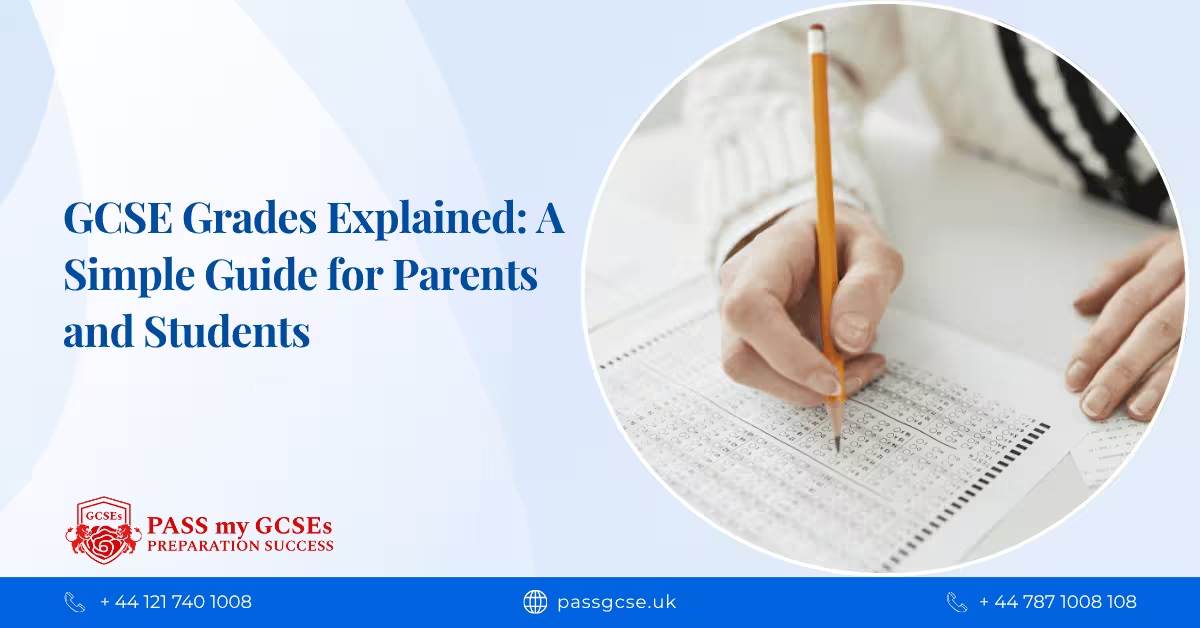
GCSE Grades Explained: A Simple Guide for Parents and Students
Published on
GCSE Grades Explained: A Simple Guide for Parents and Students
If you have ever looked at a GCSE result and thought "wait, what does a grade 5 even mean?", you are not alone. A lot of parents grew up with A, B, C grades, so when their child comes home with a number instead of a letter, it can feel confusing. The good news is that once you understand it, it is actually quite simple.
In this guide, we will break down exactly how GCSE grades work, what counts as a good grade, and what your child needs to move on to Sixth Form. No confusing terms, just simple explanations anyone can follow.
What Are GCSE Grades, and Why Do They Matter So Much?
GCSEs are exams that most students in the UK take at the end of Year 11. The grade your child gets in each subject is basically a score that shows how well they understood that subject and how well they performed in the exam.
These grades matter more than they might seem. Schools use them to decide which courses a student can join in Sixth Form. Later on, universities and even some employers look back at GCSE results too. So while it is just one set of exams, it quietly shapes a lot of doors that open or stay closed later.
The New GCSE Grading System Explained Simply
A few years ago, the UK changed how GCSEs are graded. Instead of letters like A*, A, B, C and so on, GCSEs are now graded using numbers from 9 down to 1. Nine is the highest grade a student can get, and one is the lowest actual grade. If a student does not reach the minimum required marks, they get an unclassified result, shown as U.
How the Number Grades Compare to Old Letter Grades
Here is a simple table that shows roughly how the new number grades line up with the old letter grades, along with what they generally mean.
New Grade | Old Grade | What It Means |
9 | Top A* | Outstanding result |
8 | High A* | Excellent result |
7 | A | Strong result |
6 | B | Good result |
5 | High C / Low B | Strong pass |
4 | C | Standard pass |
3 | D / E | Below pass level |
2 | F | Low result |
1 | G | Very low result |
U | U | Unclassified, no grade given |
Standard Pass vs Strong Pass, What Is the Difference?
This is one of the most common questions parents ask, and it is simple once explained clearly.
Grade 4 is known as a standard pass. It is the basic level most schools and the government count as a pass.
Grade 5 is known as a strong pass. Many schools, especially for Sixth Form entry, prefer to see grade 5 or above, particularly in English and Maths.
So while a grade 4 does technically count as a pass, aiming for a grade 5 gives your child a much stronger position when applying for Sixth Form courses later on.
Why Do Grade Boundaries Keep Changing Every Year?
Here is something that surprises a lot of parents. The number of marks needed to get a certain grade is not exactly the same every single year. This is called a grade boundary, and it can shift slightly from one year to the next.
Why does this happen? Simply because exam papers are not always equally difficult. If a paper turns out to be a bit harder one year, the boundary for each grade is adjusted slightly lower, so students are not unfairly punished for a tougher exam. This keeps things fair for everyone, no matter which year they happen to sit their exams.
Once exams are marked, a student's raw score is compared against that year's boundary to work out their final grade. This is also why two students with a similar percentage score, but from different years, might end up with slightly different grades.
What Grades Does a Child Need for Sixth Form?
This is usually the big question on every parent's mind, especially as GCSEs get closer.
General Requirements
Most Sixth Forms ask for at least five GCSE passes at grade 4 or above, and this almost always needs to include English and Maths.
Requirements for Specific A Level Subjects
If your child wants to study a subject at A Level, schools often expect at least a grade 6 in that same subject at GCSE. For subjects that are naturally more demanding, like Maths, Sciences or Economics, schools may ask for grade 7 or higher.
Why English and Maths Carry So Much Weight
English and Maths are treated a little differently from other subjects. Almost every Sixth Form and university looks closely at these two, since they show a student's core reading, writing and number skills. If a child does not reach at least a grade 4 in these subjects, they will usually need to resit them.
What If the Grades Are Lower Than Expected?
If results come in lower than hoped, it is not the end of the road at all. There are still several paths forward, such as resitting a subject, choosing a different Sixth Form route, or looking into vocational courses that focus on practical skills.
What matters most at this stage is having the right support to strengthen weak areas quickly and calmly. This is exactly where good preparation can turn things around. Our GCSE tutors work closely with students to identify exactly where marks were lost, and build a simple plan to fix those gaps before a resit or the next set of exams.
How to Help Your Child Aim Higher
The good news is that GCSE grades are not fixed in stone months before the exam. With the right habits and support, most students can improve their scores quite a bit. Here are a few things that genuinely help.
1. Regular, Structured Revision
Trying to learn everything in the last few weeks rarely works well. Steady, planned revision spread out over time helps information stick properly. Our GCSE revision courses are built around this idea, breaking each subject down into manageable chunks so nothing feels overwhelming.
2. Practising With Real Past Papers
One of the simplest and most effective ways to improve is by practising with real exam questions. This helps a child get used to how questions are worded and how much detail examiners expect. We always encourage students to work through genuine GCSE past papers, since nothing prepares a child for the real exam quite like practising with the real thing.
3. Sitting Mock Exams Under Real Conditions
Knowing the content is only half the battle. Many students lose marks simply because they are not used to timed conditions or exam pressure. That is why our GCSE mock exams are designed to feel just like the real thing, helping students walk into their actual exam feeling calm, familiar and prepared rather than anxious.
4. One to One Support Where It Is Needed Most
Every child struggles with different topics. Group classes cannot always slow down for one student, which is why personal, one to one guidance often makes the biggest difference. A good tutor can spot exactly where a student is losing marks and fix it quickly, rather than covering the whole syllabus at the same pace for everyone.
GCSE TUITION
Ready to Help Your Child Succeed in Their GCSEs?
Join hundreds of families who trust Pass GCSE for expert tuition, proven results, and a clear path to exam success.
Grades Are Important, But They Are Not the Whole Story
It is worth remembering that GCSE grades, while important, are not the only thing that matters. Schools also look at a student's effort, attitude and willingness to improve. A student who works hard, asks questions and keeps practising will often go on to do very well, even if their first mock result was not perfect.
This is exactly why we believe in steady, supportive preparation rather than last minute panic. With the right guidance, whether that is through tutoring, structured revision courses, timed mock exams, or simply practising past papers, every child has the chance to walk into their GCSEs feeling ready and confident.
Frequently Asked Questions
What is the GCSE grading system in simple terms?
GCSEs are now graded on a scale from 9 to 1, with 9 being the highest. This replaced the older letter system of A* to G, and gives a clearer picture of top level performance.
Is a grade 5 considered good?
Yes, grade 5 is called a strong pass. Many Sixth Forms prefer students to have grade 5 or above, especially in subjects they plan to continue studying further.
What is the difference between grade 4 and grade 5?
Grade 4 is the standard pass, meeting the basic requirement. Grade 5 is a strong pass and is generally seen as a more solid result for moving ahead academically.
Do GCSE grade boundaries change every year?
Yes, boundaries can shift slightly each year depending on how difficult that year's exam papers were. This keeps results fair across different years.
What grades are needed to get into Sixth Form?
Most Sixth Forms ask for at least five grade 4s or above, including English and Maths. Some competitive courses may ask for grade 5 or higher.
Can a child improve their GCSE grades close to the exam?
Yes, with focused revision, regular practice papers and realistic mock exams, many students see noticeable improvement even in the weeks leading up to their exams

Mr Singh
Founder, Pass My GCSE
Mr Singh is the founder of Pass My GCSE, with over 30 years of teaching experience. Having overcome academic setbacks himself, he is passionate about ensuring no child struggles alone. His approach focuses on personalised support, strong foundations, and building confidence. He has helped students achieve outstanding results in 11+ and GCSE examinations
Loading related posts…
Ready to Transform Your Child's GCSE Results?
Join hundreds of Birmingham families who trust Pass My GCSE to deliver real, measurable results.