Loading page…
How to Pass GCSE: 12 Proven Steps That Actually Work
Published on
Key Takeaways
To pass GCSE exams, aim for a grade 4 or above in every subject, and get there by starting revision early, condensing notes into your own words, testing yourself instead of rereading, spacing out review sessions, and practising real past papers under timed conditions. None of these steps alone guarantees a pass, but done consistently from Year 10 onwards, together they cover almost everything that separates a confident pass from a last minute scramble.
What Does "Passing" a GCSE Actually Mean?
A GCSE pass means achieving a grade 4 or above on the 9 to 1 scale, officially known as a standard pass. Grade 5 is a strong pass, and is what many more competitive sixth forms and colleges prefer to see, particularly in English and Maths. For a full breakdown of what every grade actually represents, our guide to GCSE grades explained covers this in detail, and our guide on whether a grade 4 counts as a pass looks specifically at what that grade opens up.
There is no single fixed raw score needed to pass, since exam boards set grade boundaries fresh after every exam series depending on how demanding that year's papers were. Our guide to GCSE grade boundaries explains exactly how and why these shift year to year.
12 Proven Steps to Pass Your GCSEs
1. Start in Year 10, Not the Spring of Year 11
Year 11 disappears faster than it seems it will. Mocks land in November, coursework deadlines pile up in January, and half terms vanish. Starting properly in Year 10 does not mean hours of revision every night, it means keeping condensed notes as topics are taught, doing end of topic questions properly the first time, and never letting a confusing topic slide by half understood. Do that, and Year 11 becomes genuine revision, not emergency learning.
2. Condense Every Topic Down to One Page
Read through notes for a topic, close the book, and summarise it in your own words on a single page, whether that is a bullet list, a mind map, or a flow chart. The act of squeezing information down forces a decision about what actually matters, and the result is a revision tool that takes minutes to reread, not an hour, which means it will actually get reread.
3. Master One Topic at a Time
Many students revise in a wide, thin layer, touching every topic briefly and mastering none. It works far better to take one topic and stay with it until questions on it genuinely stop going wrong, rather than moving on the moment one answer is correct. One right answer proves it is possible once, not that it will hold up reliably in the exam hall.
4. Test Yourself Instead of Rereading
Rereading notes feels productive and achieves surprisingly little, since the brain simply recognises familiar words rather than genuinely storing them. Active recall, covering the page and writing down what is remembered, using flashcards, or explaining a topic aloud to someone with no knowledge of it, forces real retrieval. It feels harder because it is harder, and that is exactly why it works.
5. Space Out Revision and Keep Revisiting Old Topics
Ticking a topic off a checklist creates a false sense that it is done forever. Memory fades, and something revised once in October is often gone by May. A schedule that deliberately revisits older topics, today, again in a few days, again in a couple of weeks, again a month later, keeps information genuinely embedded rather than temporarily borrowed.
6. Practise Genuine Past Papers
Topic questions teach content. Full past papers teach something content alone cannot, switching between topics, managing the clock, and coping when one question turns out harder than expected. We always recommend working through authentic past papers, organised clearly by subject, board and tier with mark schemes attached, aiming for at least three full papers per subject before study leave, each one marked and properly reviewed.
7. Practise Under Real Exam Conditions
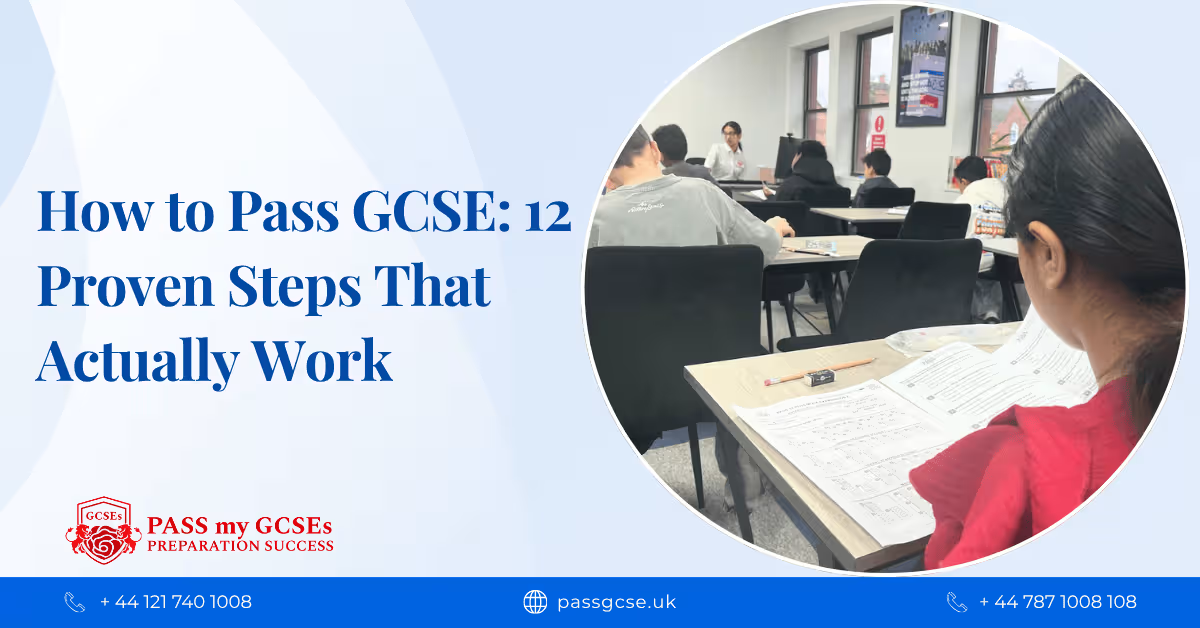
Even well prepared students often say the exam hall itself feels strange, the silence, the rows of desks, the clock. Taking away that strangeness simply means rehearsing it, setting a timer for the real duration, keeping notes and phones out of the room, and sitting through the whole paper even after finishing early. By the fourth practice run, a real exam hall starts to feel like just another rehearsal.
8. Mark Your Own Work Against the Mark Scheme
Knowing a topic does not automatically earn full marks, answering exam questions well is a separate, learnable skill. Marking practice papers honestly against the official scheme reveals patterns, the exact wording examiners want, how many points a four mark question actually needs, when working out earns credit even without a correct final answer. This single habit gains marks without learning a single new fact.
9. Keep a Mistakes Book
A wrong answer is not a failure, it is free information about exactly where marks are hiding. Writing down every mistake, what the correct approach was, and why it went wrong, then returning to attempt the same question two or three weeks later, shows clearly whether the learning actually stuck.
10. Be Honest About What You Do Not Understand
"Fine" is the easiest word to say when a teacher asks how revision is going. It is also the most expensive, since nobody can help close a gap they do not know exists. Saying the harder, more useful sentence, "I still don't understand this topic", to a teacher, tutor or friend, is what actually gets a gap fixed before it grows.
11. Protect Sleep, Food and Focus
This is exam strategy, not soft advice. A tired brain struggles to retrieve what a rested brain stored properly, and skipping breakfast on exam morning costs concentration in the final stretch of a long paper. A phone left on the desk during revision, even switched off, quietly divides attention. Ninety minutes of properly undivided focus consistently beats four hours of half attention.
12. Get Targeted Help Where the Gap Has Grown Too Wide
Almost every student has one or two subjects where a gap opened up months ago, one missed topic, everything built on top of it wobbling, confidence draining away with it. Working harder at the same thing rarely fixes this. What helps is someone finding the original gap, explaining it a few different ways until one lands, and rebuilding properly from there, exactly what our GCSE tutors focus on with every student.
How Hard Is It to Pass, Really?
Pass rates vary quite a bit by subject. In 2024, GCSE Engineering had the lowest national pass rate in England, with only 54.5% of students achieving a grade 4 or above, according to JCQ data. That is a useful reminder that difficulty is not evenly spread across subjects, some genuinely demand more focused preparation than others, and struggling with one particular subject says very little about ability overall.
Worth remembering: the subject a friend finds hardest may not be the one that challenges you most. Preparation should be shaped around each individual subject's demands, not a single blanket approach applied to everything.
A Simple Revision Time Guide
Stage | Focus | Rough Time Guide |
Year 10 | Condensed notes, end of topic questions, no gaps left unaddressed | 45 to 60 minutes on school nights |
Year 11 autumn | Mocks, filling identified gaps, starting spaced review | 1 to 1.5 hours on school nights |
Year 11 spring and summer | Full timed past papers, mark scheme review, exam technique | 1.5 to 2.5 hours school nights, 3 to 4 hours at weekends |
Quality consistently beats raw hours. Focused 25 to 40 minute blocks with proper breaks in between outperform long, unbroken sessions every time.
What Happens If a GCSE Is Not Passed?
Not passing a GCSE first time closes far fewer doors than it feels like on results day. There are always clear next steps.
Resit English Language and Maths. A dedicated November resit series exists for these two subjects, alongside the following summer's exams. Government policy requires resits until a grade 4 is achieved or a student turns 18.
Consider Functional Skills Level 2. Many colleges and employers accept this as an alternative to GCSE English and Maths, and its assessment style suits some students far better.
Request a review of marking. If a result looks noticeably different from what was predicted, a review can be requested through the school, though it is worth knowing a grade can move down as well as up.
Talk to a chosen college before assuming the worst. Sixth forms and colleges are often far more flexible on results day than their published entry requirements suggest.
Change the approach for next time. Resitting with the exact same revision method tends to produce a similar result. Increasing past paper practice and mark scheme review, with support to find the specific original gap, is usually what actually shifts a grade upward.
Turning These 12 Steps Into a Real Plan
Reading a list of what works is the easy part, sticking to it consistently across every subject is where most students genuinely need support.
A Clear, Structured Revision Plan
Our GCSE revision courses turn these steps into an actual weekly plan, guiding students through each subject methodically rather than leaving structure to chance.
Genuine Exam Practice
We always recommend working through real past papers, organised by board, subject and tier with mark schemes attached, so every practice session reflects the real exam as closely as possible.
Realistic Mock Exams
Our GCSE mock exams recreate genuine timed conditions, so the exam hall feels familiar long before results day arrives.
Personal, One to One Guidance
Our GCSE tutors begin with a proper diagnostic assessment, finding the exact gaps holding a grade back, then teach content and exam technique side by side. You can explore our full range of support at passgcse.uk.
Conclusion
Passing GCSEs is far less mysterious than it feels in the middle of Year 11. Start early, condense notes properly, test yourself instead of rereading, revisit old topics on purpose, and practise genuine past papers under real timed conditions. Mark work honestly, keep track of mistakes, and be willing to say plainly what still does not make sense. None of these steps require natural brilliance, only consistency, and together they cover almost everything that separates a confident pass from a last minute scramble.
Frequently Asked Questions
What grade do you need to pass a GCSE?
A grade 4 or above counts as a standard pass. Grade 5 is considered a strong pass and is often preferred by more competitive sixth forms, particularly in English and Maths.
When should GCSE revision actually start?
Ideally at the start of Year 10, focusing on learning content properly the first time and keeping condensed notes, rather than waiting until the spring of Year 11 to begin serious revision.
What is the single most effective GCSE revision technique?
Practising genuine past papers under timed conditions, then marking them honestly against the official mark scheme, is consistently one of the most effective habits a student can build.
What is the hardest GCSE subject to pass?
Pass rates vary by subject each year. In 2024, GCSE Engineering had the lowest national pass rate in England, according to JCQ data, though the subject a student finds hardest is always personal to them.
What happens if a student does not pass a GCSE?
Options include resitting, particularly required for English and Maths until a grade 4 is reached or the student turns 18, considering Functional Skills Level 2, requesting a review of marking, or speaking directly to a chosen college about flexibility.

Mr Singh
Founder, Pass My GCSE
Mr Singh is the founder of Pass My GCSE, with over 30 years of teaching experience. Having overcome academic setbacks himself, he is passionate about ensuring no child struggles alone. His approach focuses on personalised support, strong foundations, and building confidence. He has helped students achieve outstanding results in 11+ and GCSE examinations
Loading related posts…
Ready to Transform Your Child's GCSE Results?
Join hundreds of Birmingham families who trust Pass My GCSE to deliver real, measurable results.