Loading page…
What Happens If You Fail Your GCSEs? Your Complete Next Steps Guide
Published on
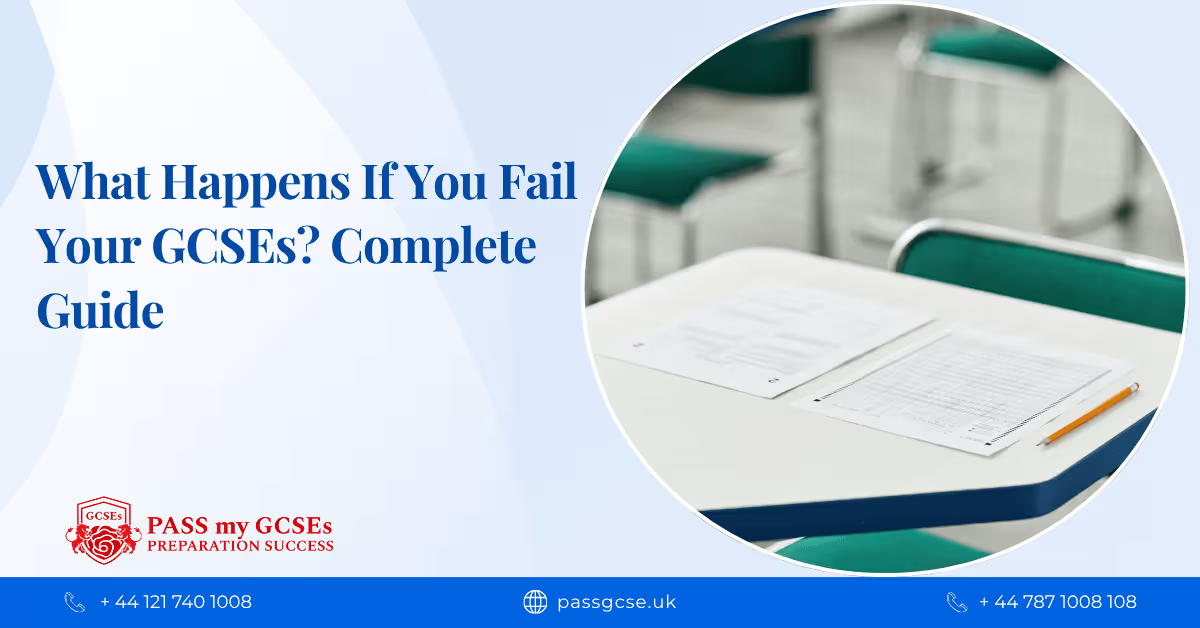
Failing a GCSE means scoring below a grade 4, and it is far more common than it feels on results day, around a third of all GCSE entries in England do not reach a grade 4 each year. It is not the end of the road. For Maths and English Language specifically, you are legally required to keep studying until you pass or turn 18, but for every other subject, resitting is entirely your choice, and routes like sixth form, apprenticeships, BTECs and university all remain genuinely open.
If results day has not gone the way you hoped, take a breath first. Thousands of students are in exactly this position every single year, and there are more paths forward than most people realise on the day itself. This guide explains precisely what failing a GCSE means, the specific rules around Maths and English, every option available to you, and how to give a resit a genuinely better chance of success.
Key Takeaways
Grade 4 or above is a pass. Grade 3 or below is generally considered a fail.
Maths and English Language must be retaken until a grade 4 is achieved or you turn 18, this is a legal requirement, not a school policy.
For every other subject, resitting is entirely optional.
Resit pass rates are notably lower than first attempts, in November 2025 just 34.9% of English resit students and 23.2% of Maths resit students achieved a grade 4, which makes proper preparation genuinely important.
Sixth form, college, apprenticeships and university remain realistic options even after a failed GCSE.
What Does It Actually Mean to Fail a GCSE?
GCSEs in England are graded from 9 to 1. Grade 4 is known as a standard pass, and grade 5 is a strong pass. A grade 3 or below is generally considered a fail. For the full picture of how every grade lines up, our guide to GCSE grades explained breaks down the whole 9 to 1 scale, and our guide on whether a grade 4 counts as a pass looks specifically at what that grade unlocks.
It genuinely is more common than it feels in the moment. In summer 2025, around 32.6% of all GCSE entries in the UK, roughly one in three, did not achieve a grade 4 or above. If this is where you find yourself, you are very far from alone.
What Happens Specifically If You Fail Maths or English Language?
Maths and English Language are treated differently from every other GCSE subject. Government policy, sometimes called the condition of funding requirement, means you must keep working towards a grade 4 in these two subjects until you achieve it or turn 18. Exactly what that looks like depends on your grade and situation.
Your Situation | What Happens Next |
Grade 3, studying full-time (540+ hours) | You must resit the GCSE |
Grade 3, studying part-time (150 to 539 hours) | Choice between a GCSE resit or a Functional Skills qualification |
Grade 2 or below | You can take a Functional Skills qualification instead of a GCSE |
On an apprenticeship | You continue studying Maths and English as part of your training |
The good news is that if you are resitting Maths or English Language because you did not reach a grade 4, you will not have to pay to sit the exam, the cost is covered.
What Is a Functional Skills Qualification?
Functional Skills is an alternative to GCSE that focuses on the practical, everyday use of Maths and English. Many employers and colleges accept it as equivalent, and its format tends to suit students who found the traditional GCSE exam experience particularly stressful or found the full GCSE content overwhelming. One thing worth checking, not every university accepts Functional Skills in place of GCSEs, particularly for competitive courses, so it is always worth confirming with the specific institution before committing to this route.
Do You Have to Resit Every Other Failed Subject?
No. Outside Maths and English Language, resitting is entirely your choice. If you failed a subject that has no bearing on your future plans, you are under no obligation to retake it. That said, if a failed subject is genuinely holding you back from a specific next step, a resit can still be worth pursuing.
Your Main Options After Failing a GCSE
1. Resit the GCSE
Most subjects can be resat in November or the following summer, though Maths and English Language are the two subjects consistently offered in the November series. If you are still at school or college, your institution will usually enter you automatically. If you have left, you can register as a private candidate through an exam centre, though you will need to arrange this yourself and pay a fee, ideally booking around six months ahead of your exam date. Both your original and resit grades appear on your results transcript, and for things like UCAS applications, you can use whichever grade is higher.
2. Retake Alongside New Qualifications
Many colleges and sixth forms will let you start A Levels or another course the following year while resitting a failed GCSE alongside it. This usually means adding the GCSE class to your new timetable. It is always worth having this conversation directly with your chosen college, since many are genuinely flexible, particularly around one failed subject.
3. Explore Vocational and Technical Qualifications
If exams are not your strongest format, BTECs, T Levels and NVQs are all genuine alternatives, built around coursework and practical, work focused learning rather than final written exams.
Qualification | What It Involves | Level / Equivalent |
BTEC | Practical, coursework based, across a wide range of subjects | Level 2 = GCSE equivalent, Level 3 = A Level equivalent |
T Level | Classroom learning plus a substantial industry placement | Equivalent to 3 A Levels |
NVQ | Job role specific, practical workplace skills | Level 2 = GCSE equivalent, up to Level 7 = Masters equivalent |
4. Start an Apprenticeship
Apprenticeships let you earn a wage while training, generally structured around 80% on the job learning and 20% study, often at a college. They run from one to six years depending on level, and cover an enormous range of industries, from engineering and healthcare to digital technology and business. Entry requirements depend on the employer and level, but for a Level 2 apprenticeship you often do not need existing qualifications, since Maths and English Functional Skills are frequently built into the training itself.
5. Consider a Different Career Path Entirely
If resitting does not appeal, this can genuinely be a moment to rethink direction based on the strengths you already have. Access courses, entry level jobs, work experience, volunteering and professional qualifications, such as those in accountancy, HR or IT, are all realistic routes that do not always require a specific set of GCSEs to begin. If you are strong in English, for example, careers in journalism, marketing or content writing are worth exploring, many employers in these fields value experience and creativity just as highly as formal qualifications.
Can You Appeal Your GCSE Results?
Yes. If you believe there has been a genuine error, or your grade does not reflect how you feel you performed, you can request a review through your school, college or exam centre, who will submit this to the exam board on your behalf. Private candidates can request this directly through the centre where they sat their exam. It is worth knowing a grade can move down as well as up following a review, so this route tends to be most worthwhile when a result looks noticeably different from what was genuinely expected.
Can You Still Go to Sixth Form, College or University?
In most cases, yes. A typical entry requirement for A Levels is five GCSEs at grade 4 or above, including English and Maths, but if you are missing more than one, you may be asked to start at Level 2 rather than Level 3, or your college may recommend an alternative course. Universities generally focus on A Level grades or equivalent qualifications rather than every individual GCSE, though most do still expect a grade 4 or above in English Language and Maths specifically. Some universities also offer a foundation year, an additional year of study before the main degree, as a route in for students who do not meet standard entry requirements. Our guide on what to do after GCSEs covers A Levels, T Levels, apprenticeships and traineeships in more depth.
Always ask before assuming a door is closed. Colleges and sixth forms are frequently more flexible on results day than their published entry requirements suggest, especially where a grade sits close to the boundary. Our guide to GCSE grade boundaries explains exactly how close a "near miss" might actually be.
Five Ways to Give a Resit a Genuinely Better Chance
Resit pass rates are notably lower than first attempts, in November 2025 just 34.9% of English resit students and 23.2% of Maths resit students achieved a grade 4. That gap is not a reason to feel discouraged, it is a clear signal that repeating the exact same approach rarely produces a different result. A different, more targeted plan genuinely changes the odds.
1. Find Out Exactly Where Marks Were Lost
You can request a copy of your marked exam paper through your school or as a private candidate. Seeing precisely where marks slipped away tells you exactly what to focus on, rather than revising everything from scratch and wasting valuable time.
2. Practise With Genuine Past Papers Under Timed Conditions
Sitting real past papers under proper timed, silent conditions, then marking honestly against the official scheme, remains one of the most effective ways to prepare for a resit.
3. Focus Revision on Your Weakest Topics First
Rather than starting from the very beginning and covering everything evenly, concentrate extra time on the three or four topics that caused the most trouble first time round. This moves a grade further, faster, than revisiting content already understood well.
4. Learn Exactly What Examiners Are Looking For
How an answer is written matters just as much as whether the content is correct. Reviewing model answers and official mark schemes for your subject and exam board shows precisely what needs to be included to earn full marks.
5. Build a Study Routine You Can Actually Stick To
Short, focused sessions spread across several weeks consistently beat cramming everything into the final days. Even 20 to 30 minutes of properly focused daily revision adds up meaningfully over time.
Remember, This Is Not the End of the Story
Plenty of well known, successful people did not get the GCSE or O Level results they hoped for. Richard Branson left school with no O Levels and went on to build the Virgin group. Alan Sugar left school with a single O Level before becoming a successful entrepreneur and television personality. Actor Maisie Williams left school with no GCSEs before landing one of the biggest television roles of her generation. None of this is meant to suggest results do not matter, they genuinely do, but a difficult results day is a starting point, not a life sentence.
Turning a Resit Into a Genuine Pass
Knowing your options is the first step. Turning a second attempt into a confident pass is where the right structure and support make the real difference.
A Clear, Structured Revision Plan
Our GCSE revision courses guide resit students through exactly the gaps that held their grade back, rather than starting again from scratch.
Genuine Exam Practice
We always recommend working through real past papers, complete with official mark schemes, so revision reflects the real exam as closely as possible.
Realistic Mock Exams
Our GCSE mock exams recreate genuine timed conditions, helping resit students walk in feeling calm and prepared rather than anxious about repeating past nerves.
Personal, One to One Guidance
Our GCSE tutors start by identifying the exact gap that held a grade back the first time, then rebuild understanding and exam technique together, so a resit becomes a genuinely different attempt, not a repeat of the same one. You can explore our full range of support at passgcse.uk.
Conclusion
Failing a GCSE is disappointing, and it is completely normal to feel that way on results day. What matters far more is what happens next. Maths and English Language come with clear, legally required next steps, while every other subject leaves the choice genuinely in your hands. Sixth form, college, apprenticeships, vocational qualifications and university all remain realistic paths forward, and with the right, more targeted preparation, a resit gives every student a genuine second chance to reach the grade they are capable of.
Frequently Asked Questions
What grade counts as a fail at GCSE?
Grade 4 is the standard pass. Anything below a grade 4, so grades 3, 2 or 1, is generally considered a fail.
Do you have to resit a failed GCSE?
Only Maths and English Language are compulsory to keep resitting until a grade 4 is achieved or you turn 18. Every other subject is entirely optional to retake.
How many times can you resit a GCSE?
There is no official limit. You can resit as many times as needed, and for English and Maths, you must keep resitting until you achieve a grade 4 or turn 18.
Can you still go to university if you failed a GCSE?
Yes, in most cases. Universities generally focus on A Level grades or equivalent qualifications, though most do still require a grade 4 or above in GCSE English Language and Maths specifically.
Is it too late to turn a GCSE result around?
No. With the right preparation, focused on the specific topics and technique that held a grade back the first time, students improve their GCSE results through resits all the time.

Mr Singh
Founder, Pass My GCSE
Mr Singh is the founder of Pass My GCSE, with over 30 years of teaching experience. Having overcome academic setbacks himself, he is passionate about ensuring no child struggles alone. His approach focuses on personalised support, strong foundations, and building confidence. He has helped students achieve outstanding results in 11+ and GCSE examinations
Loading related posts…
Ready to Transform Your Child's GCSE Results?
Join hundreds of Birmingham families who trust Pass My GCSE to deliver real, measurable results.