Loading page…
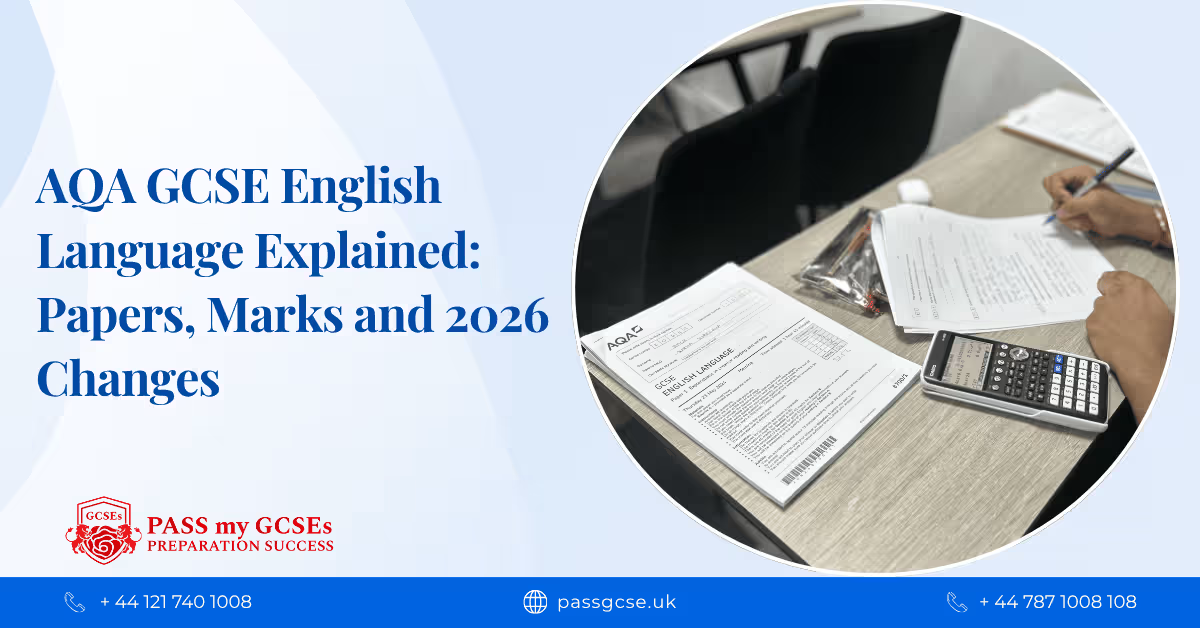
AQA GCSE English Language Explained: Papers, Marks and 2026 Changes
Published on
If you are sitting AQA GCSE English Language, you have probably already noticed there is no single set text to revise from, no clear list of facts to memorise the night before. Instead, the exam tests how well you can read closely, think critically, and write clearly under time pressure. That can feel a little harder to prepare for, but once you understand exactly how the exam is built, it becomes far less mysterious.
In this guide, we will break down both AQA English Language papers, explain what examiners are actually looking for, cover the changes coming in 2026, and share simple, practical ways to prepare with real confidence.
Key Takeaways
AQA GCSE English Language is made up of two written papers, plus a separate speaking assessment that does not count towards your final grade.
Each paper lasts 1 hour and 45 minutes and is worth 80 marks, making up half of the overall grade.
Paper 1 focuses on fiction, while Paper 2 focuses on non fiction.
From 2026, AQA is introducing multiple choice questions, separate reading and writing marks, and a stronger focus on spelling, punctuation and grammar.
Grade boundaries shift slightly every year, so it is safest to aim well above any specific number.
What Does the AQA English Language Exam Actually Look Like?
The AQA GCSE English Language qualification is made up of the following.
Two written papers, with 160 marks available in total
Each paper lasts 1 hour and 45 minutes and is worth 80 marks
Both papers are equally weighted, each making up half of the final grade
A non exam speaking assessment also takes place, but this is reported separately and does not count towards your overall GCSE grade
Paper 1 vs Paper 2, What's the Real Difference?
Both papers are the same length and worth the same number of marks, but they test genuinely different skills and text types.
Paper 1: Explorations in Creative Reading and Writing
Focuses on fiction, combining reading and writing based questions
Section A asks a series of questions based on an unseen fiction extract
Section B asks you to write a creative piece, choosing from one of two given prompts
Paper 2: Writers' Viewpoints and Perspectives
Focuses on non fiction, again combining reading and writing questions
Section A asks a series of questions based on unseen non fiction texts provided in the paper
Section B asks you to write a longer non fiction piece, such as a speech or an article
What's Changing for AQA English Language in 2026?
AQA has confirmed a handful of updates to the English Language assessment for summer 2026, so it is well worth knowing about these ahead of exam day.
Paper 1 will introduce a new multiple choice format for the opening questions
Reading and writing sections will now be given separate marks, rather than one combined score
Correct spelling, punctuation and grammar will carry more weight towards the final grade
The exam will place a stronger focus on 19th century texts
AQA has also aimed to make its overall question wording clearer and more accessible
Worth knowing: since spelling, punctuation and grammar now matter even more, it is a great idea to build a quick proofreading habit into every piece of timed writing practice, even in the final few minutes of an exam.
What Are Examiners Actually Looking For?
AQA English Language marks students against four official assessment objectives, often shortened to AO1 to AO4. Understanding these can make a real difference to how you approach every answer.
Assessment Objective | What It Means |
AO1 | Identifying and interpreting both clear and hidden meanings, then selecting the right evidence from the text |
AO2 | Explaining and analysing how writers use language, structure and form to create effects, referencing relevant techniques |
AO3 | Comparing writers' ideas and viewpoints, and how these are presented across different texts |
AO4 | Critically evaluating texts, and writing your own work clearly, effectively and accurately |
In simple terms, examiners want proof that you can understand a text deeply, explain how the writer achieves their effect, and then write confidently and accurately yourself.
What About Grade Boundaries?
It is worth remembering that exact grade boundaries are only confirmed after the exam has taken place, and they shift slightly every year. Exam boards adjust these boundaries depending on how demanding that year's paper was, and how the whole group of students performed nationally. This keeps things fair, so a grade 5 reflects a similar standard of work no matter which year a student happens to sit their exam.
Since boundaries can move around slightly year to year, the safest strategy is always to aim comfortably above any target number, rather than treating a single past boundary as a fixed goal.
Five Simple Ways to Prepare for AQA English Language
1. Sharpen Your Analytical Skills
A big part of English Language is proving you can properly analyse a text. Every time you read something, try annotating for language techniques, such as metaphors, similes and rhetorical questions, as well as structural choices. Constantly ask yourself, why did the writer choose this, and what effect does it create for the reader? Always back up your analysis with a short, well chosen quote.
2. Practise Writing Little and Often
Since both papers include a writing task, regular short practice matters far more than occasional long sessions. Get comfortable using a simple structure, such as Point, Evidence, Explain, Link, to organise your paragraphs clearly. Practising under timed conditions, using genuine past papers, helps writing feel natural rather than rushed on the day.
3. Get Comfortable Comparing and Contrasting
Both papers ask you to compare texts at some point, so this is a skill worth practising deliberately. Try comparing vocabulary, tone, viewpoint and structure across two extracts, and think carefully about how to organise your comparison clearly, rather than jumping between ideas.
4. Practise With Real Past Papers and Mark Schemes
Testing yourself with genuine exam questions builds speed, accuracy and real confidence. We always recommend working through authentic past papers under proper timed conditions, since nothing prepares you for the real exam quite like practising with the real thing.
5. Recreate Real Exam Conditions
Try sitting a full paper without notes, strictly timed, then mark your own work honestly using the official AQA criteria, or swap papers with a friend. Afterwards, reflect on your timing, your planning, and which sections felt hardest, so the next practice round improves on the last.
Turning This Into a Real Revision Plan
Understanding the exam format is only the first step. The real progress comes from turning that understanding into consistent, focused practice.
Personal, One to One Guidance
Every student has different strengths across reading and writing. Our English GCSE tutors work closely with each student, focusing lessons on exactly what they need, whether that is sharpening analysis, tightening essay structure, or building confidence with creative writing.
A Clear, Structured Revision Plan
Rather than revising randomly, a guided structure keeps English Language revision focused and manageable. Our GCSE revision courses walk students through both papers step by step, covering reading and writing skills side by side.
Practise Under Realistic, Timed Conditions
Getting comfortable with the real pressure of a 1 hour 45 minute paper matters just as much as knowing the content. Our English mock exams recreate the real exam experience closely, helping students walk in feeling calm and genuinely prepared.
Studying English Literature Too?
If your child is also sitting English Literature alongside Language, we have dedicated support for that as well. Our English Literature revision course and English Literature past papers are built specifically around set texts and poetry analysis, so both English GCSEs are covered with the same focused approach.
Conclusion
AQA GCSE English Language is designed to test a genuinely broad range of reading and writing skills, not simply memorised facts. With a clear understanding of both papers, what examiners are really looking for, and the 2026 changes on the horizon, students can prepare with real focus rather than vague worry. Combined with steady practice and honest feedback, that preparation is exactly what turns exam day nerves into exam day confidence.
Frequently Asked Questions
How many papers make up AQA GCSE English Language?
There are two written papers, each worth 80 marks and lasting 1 hour and 45 minutes, along with a separate speaking assessment that does not count towards the final grade.
What is the difference between Paper 1 and Paper 2?
Paper 1 focuses on fiction, with unseen extract questions and a creative writing task. Paper 2 focuses on non fiction, with unseen text questions and a longer non fiction writing task, such as a speech or article.
What is changing in AQA English Language for 2026?
Changes include a new multiple choice section on Paper 1, separate marks for reading and writing, more weight given to spelling, punctuation and grammar, and a stronger focus on 19th century texts.
Do grade boundaries stay the same every year?
No, grade boundaries are confirmed after each exam and can shift slightly year to year, depending on how the paper and the wider group of students performed.
What is the best way to prepare for English Language?
Regular, focused practice works best, including analysing texts closely, writing under timed conditions, comparing texts, and working through genuine past papers with mark schemes.

Mr Singh
Founder, Pass My GCSE
Mr Singh is the founder of Pass My GCSE, with over 30 years of teaching experience. Having overcome academic setbacks himself, he is passionate about ensuring no child struggles alone. His approach focuses on personalised support, strong foundations, and building confidence. He has helped students achieve outstanding results in 11+ and GCSE examinations
Loading related posts…
Ready to Transform Your Child's GCSE Results?
Join hundreds of Birmingham families who trust Pass My GCSE to deliver real, measurable results.