GCSE Revision Course vs Private Tutor: Which Should You Choose?
Published on
Your child has GCSEs coming up and you want to help. Two options come up again and again: a revision course or a private tutor. Both can work well. They just solve different problems. This guide explains the difference in plain English, so you can pick the one that fits your child.
Choose a GCSE revision course if your child needs a clear plan, full topic coverage and exam practice before the exams. Choose a private tutor if your child is struggling with certain topics and needs one to one help that follows their pace. Many students do best with a mix of both.
Key Takeaways
A revision course follows a set plan and covers the whole syllabus in order.
A private tutor builds lessons around your child's own gaps and questions.
Courses suit students who know the content but need structure, speed and exam practice.
Tutors suit students who are stuck, behind or anxious and need personal attention.
The best choice depends on your child's grade, confidence and how much time is left.
What Is a GCSE Revision Course?
A revision course is a planned programme that takes students through the key topics of a subject before the exams. It usually follows the exam board's specification, so nothing important is missed. Students go through topics step by step, practise exam style questions and learn how marks are won.
It is a bit like a map. Your child always knows where they are, what comes next and how close they are to the finish line. You can see how this works in our GCSE revision courses.
What Is a Private GCSE Tutor?
A private tutor teaches your child one to one. The lessons are built around what your child needs. If fractions are the problem, the tutor spends time on fractions. If essay writing is the issue, they work on essays. The tutor can slow down, speed up and explain a topic in a new way until it clicks.
It is less like a map and more like a personal guide. Our GCSE tutors work this way, one to one and online from home.
GCSE Revision Course vs Private Tutor: Side by Side
What matters | Revision course | Private tutor |
Main goal | Cover the whole syllabus and practise for the exam | Fix your child's specific gaps |
Structure | Fixed plan, set order of topics | Flexible, changes every lesson |
Personal attention | Shared with other students | One to one, all for your child |
Best for | Students who know most content but need structure | Students who are stuck, behind or lacking confidence |
Exam practice | Built in, with a clear timetable | Included when the tutor plans it |
Cost | Often lower per student | Usually higher per hour |
Time needed | Short, focused period before exams | Works over weeks or months |
When Is a Revision Course the Better Choice?
Your child knows the basics but feels disorganised. A course gives a clear order to follow.
The exams are a few months away. A planned programme makes the most of limited time.
Your child learns well in a group. Seeing others work can keep students motivated.
You want to cover everything. A course follows the full specification, so gaps do not sneak through.
You want to manage cost. Courses can often cost less than regular one to one lessons. Our guide on how much GCSE tuition costs in the UK explains typical prices.
When Is a Private Tutor the Better Choice?
Your child is struggling with one subject or topic. One to one time finds the exact problem.
Confidence is low. A patient tutor can rebuild belief with small wins.
Your child is aiming for a big jump in grade. Personal feedback helps move a grade 3 towards a 4, or a 5 towards a 7.
School lessons move too fast or too slow. A tutor sets the pace.
Your child has a particular subject goal. We have specialist support such as our GCSE Maths tutors and GCSE English tutors.
Can You Use Both a Course and a Tutor?
Yes, and for many students this is the strongest plan. The course gives structure and covers everything. The tutor catches the topics your child finds hardest and clears up questions the same week. Think of the course as the road and the tutor as the driving lesson for the tricky bends.
A simple way to combine them:
Start with a mock exam. It shows where marks are being lost. Our GCSE mock exams are designed for this.
Follow a revision course to cover the full syllabus in a clear order.
Add tutor sessions on the weakest topics from the mock.
Practise with real papers. Download them from our GCSE past papers page.
Sit another mock and check how far the grade has moved.
How Do You Choose for Your Child?
Ask yourself these four questions:
How much time is left? Lots of time favours a tutor who can build skills slowly. Less time favours a focused course.
What is the real problem? If it is organisation and exam technique, choose a course. If it is understanding, choose a tutor.
How does your child learn? Some children love a group. Others open up only when it is just them and the teacher.
What is your budget? Courses can stretch further, and tutors can be targeted to a few key topics.
Not sure where your child fits? A short chat or an assessment will usually make the answer clear. It also helps to understand what the grades mean, so read our guide to GCSE grades explained and set a realistic target.
Common Mistakes Parents Make
Waiting too long. Starting in Year 10 gives far more choice than starting in the final weeks of Year 11. See our guide on how to pass GCSE for a simple plan.
Choosing on price alone. The cheapest option is not good value if it does not fit your child.
Skipping practice papers. Lessons help, but practice under timed conditions is what builds exam confidence.
Ignoring your child's view. A child who likes the format will work harder at it.
GCSE TUITION
Not Sure Whether a Course or a Tutor Is Right?
Let us help you decide. Tell us your child's subjects, current grades and target grades. We will point you to the best fit, whether that is a revision course, a one to one tutor or a mix of both.
Conclusion
A revision course gives structure and full coverage. A private tutor gives personal attention and quick fixes. Neither is always better. The right choice depends on your child's needs, the time left and how they like to learn. For many families, a course plus a few tutor sessions gives the best of both.
Whichever route you choose, start early, practise with real papers and check progress with mock exams. If you would like support, visit Pass my GCSEs and we will help your child get ready with confidence.
Frequently Asked Questions
Is a GCSE revision course better than a private tutor?
Neither is better for everyone. A revision course is best for structure and covering the full syllabus. A private tutor is best for fixing specific problems with one to one help.
Is a revision course cheaper than a private tutor?
Often, yes. Courses are usually priced per student and shared in a planned programme, while one to one tutoring is charged per hour. Exact prices depend on the provider.
When should my child start GCSE revision lessons?
Ideally in Year 10, or at the start of Year 11 at the latest. Earlier starts give more time to build understanding without panic.
Can my child do a revision course and have a tutor?
Yes. A course covers the whole syllabus, and a tutor can focus on the topics your child finds hardest. This is a very effective combination.
Which is better for a child who is behind?
A private tutor is usually better for a child who is behind, because lessons move at their pace and fill the gaps. A course can follow once the basics are secure.
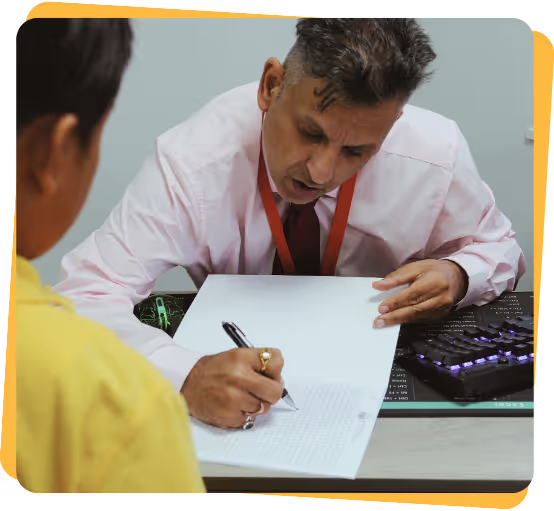
Mr Singh
Founder, Pass My GCSE
Mr Singh is the founder of Pass My GCSE, with over 30 years of teaching experience. Having overcome academic setbacks himself, he is passionate about ensuring no child struggles alone. His approach focuses on personalised support, strong foundations, and building confidence. He has helped students achieve outstanding results in 11+ and GCSE examinations
Loading related posts…
Ready to Transform Your Child's GCSE Results?
Join hundreds of Birmingham families who trust Pass My GCSE to deliver real, measurable results.