Loading page…
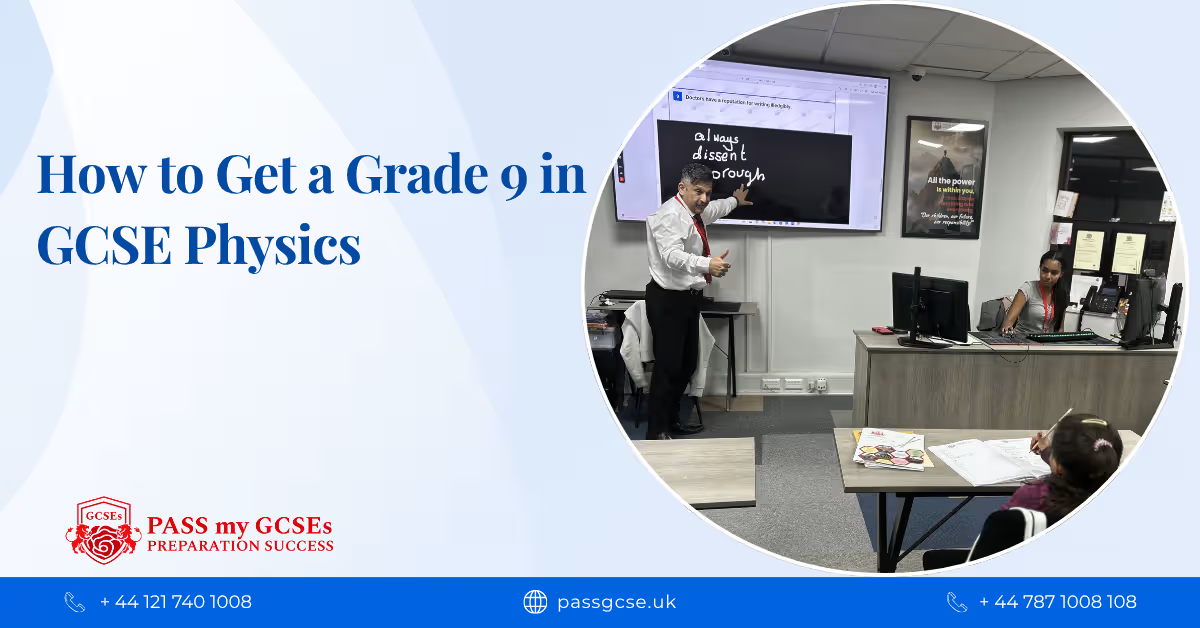
How to Get a Grade 9 in GCSE Physics
Published on
Physics has a reputation as the hardest of the three sciences, and it is easy to see why. It leans heavily on maths, it asks you to apply ideas to situations you have never seen, and a single slip with a unit or an equation can cost you a mark you thought you had. But a grade 9 in Physics is far more reachable than that reputation suggests. In AQA GCSE Physics, 13.5% of entries achieved a grade 9 in 2026, and the mark needed has typically sat between about 73% and 79% of the total. You do not need to be perfect. You need to be accurate, methodical, and well drilled on the question types that decide the top grade.
This guide breaks down exactly what the top grade demands, where students lose the marks that keep them at an 8, and the habits that close the gap.
Key Takeaways
On AQA Physics, the grade 9 boundary has recently been 147 out of 200 in 2023, 151 in 2024, 152 in 2025, and 157 in 2026, which is roughly 74% to 79% of the marks.
At least 30% of the marks in GCSE Physics test mathematical skills, the highest of the three sciences, so confident calculations are the biggest single lever you have.
The equations sheet is provided, but you still need to choose the right equation, rearrange it, convert units, and show your working.
There are 10 required practicals, and at least 15% of the marks test practical skills across both papers.
Examiners keep reporting the same errors: unit conversions, wrongly rearranged equations, and vague explanations that describe what happens without explaining why.
How Hard Is It to Get a 9 in GCSE Physics?
AQA GCSE Physics (8463) is assessed across two papers, each 1 hour 45 minutes and worth 100 marks, giving 200 in total. Paper 1 covers energy, electricity, particle model of matter, and atomic structure. Paper 2 covers forces, waves, magnetism and electromagnetism, and space physics.
The grade 9 boundary is set after marking, so it moves a little each year. Recent series have looked like this:
Series | Grade 9 | Grade 8 | Grade 7 | Grade 9 as % of 200 |
|---|---|---|---|---|
June 2023 | 147 | 133 | 120 | 73.5% |
June 2024 | 151 | 136 | 122 | 75.5% |
June 2025 | 152 | 139 | 126 | 76.0% |
June 2026 | 157 | 142 | 128 | 78.5% |
These are the published AQA boundaries as reported in recent series, so check AQA's own tables for your exact year. The pattern is clear, though. The boundary has crept up slightly, so a safe target in practice is to score around 80% on timed past papers. That gives you a cushion if your paper turns out easier than usual. If you want to understand how boundaries are set and why they move, our guide on GCSE grade boundaries explained covers it.
It also helps to know that Physics grade 9s are awarded to a smaller, strong cohort. In 2026, 45.7% of AQA Physics entries achieved a grade 7 or above, so you are being compared with a group that is already well prepared. That is one reason accuracy matters so much.
Master the Maths Behind the Physics
With at least 30% of the marks coming from mathematical skills, Physics is as much a maths exam as a science one. The students who reach a 9 are not the ones who memorise the most. They are the ones who can reliably do these things under pressure:
Pick the correct equation for the situation from the sheet.
Rearrange it without making an algebra slip.
Convert units before substituting values, for example grams to kilograms or centimetres to metres.
Show every step so that method marks are protected even if the final number is wrong.
Give the answer to a sensible number of significant figures, with the correct unit.
Examiner reports repeatedly note that candidates lose marks by forgetting to convert units first, by rearranging an equation incorrectly, or by choosing the wrong equation altogether. A simple habit fixes a lot of this: write the equation, list the values with their units, convert anything that needs converting, substitute, calculate, then write the answer with its unit.
Not every equation is given. Some must be recalled, so find out which ones your exam board expects you to know and practise them until recall is automatic. If your maths is the weak link, our guides on how to pass GCSE Maths and how to get a grade 9 in GCSE Maths build the algebra and problem-solving skills that carry straight over into Physics.
Learn to Explain, Not Just Describe
At the top of the mark range, Physics questions often ask you to explain something in several steps, using accurate scientific language. A grade 9 answer links cause and effect clearly. For example, instead of saying that a resistor "makes the current smaller", a top answer explains that increasing the resistance reduces the current for the same potential difference, because it is harder for charge to flow.
Command words decide how much you need to write. "State" wants a fact, "describe" wants what happens, "explain" wants why, and "evaluate" wants a judgement backed by evidence. Our guide on how to properly answer a GCSE exam question shows how to read a question and match your answer to it.
For the longer six-mark questions, spend a minute planning before you write. Jot down the key ideas, put them in a logical order, then write short, precise sentences. A clear structure beats a long, rambling paragraph every time.
Treat Required Practicals as a Topic of Their Own
Practical-related questions can appear on either paper, and at least 15% of the marks test practical skills. You are not asked to do an experiment in the exam. You are asked to describe a method, identify variables, spot risks, interpret results, and suggest improvements.
For each of the 10 required practicals, make sure you can answer these questions from memory:
What is the independent variable, the dependent variable, and what must be controlled?
What apparatus is used, and how is each measurement taken?
What are the main sources of error, and how would you reduce them?
What does the graph or table normally look like, and what does it show?
Students often skip this because it feels like classroom work rather than revision, which is exactly why it is one of the easiest places to pick up marks that others leave behind.
The Topics That Most Often Separate an 8 From a 9
GCSE PHYSICS TUITION
Aiming for a Grade 9 in Physics?
Get expert one-to-one Physics tuition focused on calculations, equations and the practical questions that decide the top grade.
Every topic matters, but a few tend to cause the biggest drops in the later questions of each paper:
Forces and motion. This is the largest topic on the specification and it sits on Paper 2. Be fluent with resultant forces, momentum, and the equations of motion.
Electricity. Series and parallel circuits, current-potential difference graphs, and electrical power calculations appear regularly and reward careful working.
Energy. Stores and transfers, efficiency, and specific heat capacity combine ideas and maths.
Waves and the electromagnetic spectrum. Expect explanations as well as calculations.
Radioactivity. Half-life, decay, and the properties of different radiation are popular for longer answers.
Our guide on how to pass GCSE Physics walks through the specification and revision approach in more depth, and if you are studying Combined Science rather than separate Physics, read how to get a grade 9 in GCSE Combined Science for what the top double grade needs.
Use Past Papers Like a Diagnostic Tool
Past papers are where all of this comes together, but only if you use them carefully.
Sit full papers under timed conditions. Aim for 1 hour 45 minutes with only the equipment you would have in the exam.
Mark strictly against the mark scheme. Check method marks and unit marks, not just the final answer.
Sort every lost mark. Was it a knowledge gap, a unit error, a rearranging slip, a vague explanation, or timing?
Turn patterns into practice. If rearranging keeps costing you, drill ten rearranging questions the next day. If it is explanations, rewrite your answers using the mark scheme wording.
Repeat. Come back to the same question types after a week to check the fix has stuck.
Our guide on how to use GCSE past papers goes through this in detail, and you can find genuine papers in our GCSE past papers collection and our dedicated GCSE Physics past papers page. If you are not sure where to start, our guide to free AQA past papers for GCSE Physics explains what is available and how the papers are structured.
Build a Revision Routine That Lasts
Short, regular sessions beat long, exhausting ones. A simple weekly pattern works well: one session to recall a topic from memory, one to practise calculations on it, one to attempt exam questions, and one short session to revisit an older topic so it does not fade. If you want help turning that into a real plan, our guide on a GCSE revision timetable shows how, and active recall for GCSE revision explains why testing yourself beats rereading your notes.
How We Help Students Reach a Grade 9 in Physics
The gap between an 8 and a 9 is usually narrow and specific: one kind of calculation, a habit of skipping unit conversions, or explanations that stop one step short. Spotting your own pattern is hard without detailed feedback.
Our GCSE Physics tutors work one to one with students, find exactly where marks are being lost, and correct those habits directly. Our GCSE mock exams recreate real exam conditions with detailed examiner-style feedback, so you can see how close you are to the boundary. And our GCSE revision courses are designed around the skills and topics that most reliably move a grade, giving you a clear route through the whole specification.
Conclusion
A grade 9 in GCSE Physics comes from accuracy more than from raw knowledge. Recent AQA boundaries put the top grade at roughly 74% to 79% of the marks, so you can afford a few slips, but not many. Get the maths automatic, convert units before you substitute, explain ideas in clear steps, treat the 10 required practicals as their own topic, and use timed past papers to find and fix the patterns that keep costing you marks. Done consistently, that is exactly the preparation that turns a strong Physics student into a grade 9.
Frequently Asked Questions
What percentage do you need for a grade 9 in GCSE Physics?
It varies by year because boundaries are set after marking. On AQA Physics, the grade 9 boundary has recently been between 147 and 157 out of 200, which is roughly 74% to 79%. Aiming for around 80% on timed past papers gives you a safety margin.
How much of GCSE Physics is maths?
At least 30% of the marks test mathematical skills, which is the highest of the three sciences. Calculations, rearranging equations, unit conversions, and reading graphs are therefore central to the top grades.
Is the equations sheet provided in the Physics exam?
Yes, an equations sheet is provided, but not every equation is on it, and you still need to select the right one, rearrange it, and apply it correctly. Practise with the sheet so that finding and using equations feels automatic.
How many required practicals are there in GCSE Physics?
AQA GCSE Physics has 10 required practicals, and at least 15% of the marks test practical skills. Revise each one as a topic: the method, variables, risks, sources of error, and what the results should show.
Why do I lose marks even when my physics is correct?
The most common reasons are unit errors, forgetting to convert units before substituting, rearranging an equation incorrectly, and explanations that describe what happens without saying why. Showing full working and checking units at the end protects many of those marks.

Mr Singh
Founder, Pass My GCSE
Mr Singh is the founder of Pass My GCSE, with over 30 years of teaching experience. Having overcome academic setbacks himself, he is passionate about ensuring no child struggles alone. His approach focuses on personalised support, strong foundations, and building confidence. He has helped students achieve outstanding results in 11+ and GCSE examinations
Loading related posts…
Ready to Transform Your Child's GCSE Results?
Join hundreds of Birmingham families who trust Pass My GCSE to deliver real, measurable results.