Loading page…
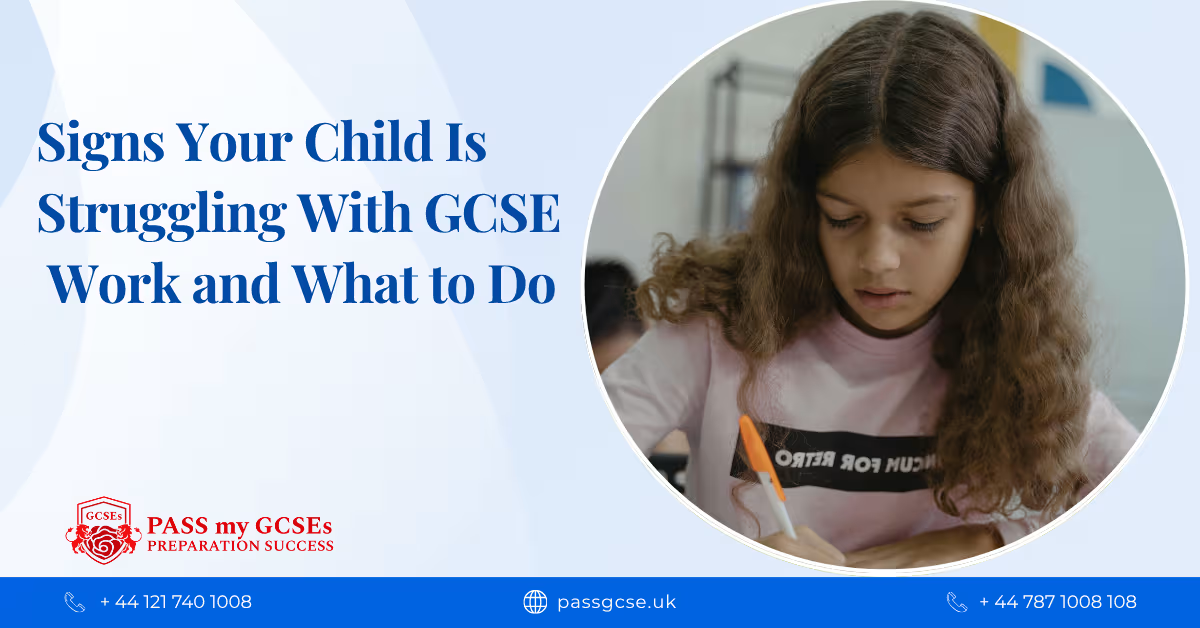
Signs Your Child Is Struggling With GCSE Work and What to Do
Published on
Most parents sense it before they can explain it. Your child seems more tired than usual, homework takes longer, or a mock result comes home that does not match the effort you have seen. The difficult part is knowing whether this is a normal wobble that will pass, or the start of a problem that needs attention now.
GCSEs are a long stretch, and almost every student hits a rough patch somewhere in it. What matters is spotting a pattern early and responding calmly and practically. This guide covers the signs that a child may be struggling with GCSE work, the most common reasons behind them, and a clear plan for what to do next, from the first conversation to getting the right support in place.
Key Takeaways
One bad test is not a pattern. Look for the same signs showing up across three or four weeks, or across several subjects, before deciding there is a problem.
Struggling usually has one of four causes: a knowledge gap, weak exam technique, ineffective revision, or confidence and wellbeing. Working out which one it is tells you what will actually help.
Start with a calm conversation and evidence (recent marks, teacher feedback, mock papers) rather than worry or pressure.
Your child's school is your first partner. Subject teachers can tell you exactly where marks are being lost and what support is available.
Extra support works best when it is targeted and linked to what is being taught in school. Education Endowment Foundation evidence shows one-to-one tuition adds about five months of progress on average, with quality and fit making the difference.
Is It a Rough Patch or a Real Problem?
Every student has weeks when they are tired, distracted, or flat. A dip after a holiday, a difficult topic, or a poor mark in one test is normal and usually passes by itself.
It becomes worth acting on when you see the same signs persist for several weeks, when they appear across more than one subject, or when they are getting worse rather than better. A useful rule of thumb is to note what you are seeing for two to three weeks. If the pattern is still there, move from watching to doing.
Ten Signs Your Child May Be Struggling With GCSE Work
Academic signs
Grades or predicted grades are falling or sitting below target. If a student who was working at a 6 is now getting 4s, or a predicted grade has dropped, find out why before the gap widens.
They keep losing marks on the same kinds of question. The same topic, the same type of calculation, or the same style of essay question coming back marked down is a clear sign of a specific gap.
Mock or test results do not match the effort. If your child is clearly revising but results stay flat, the method is usually the problem, not the effort.
They cannot explain what they have just revised. Ask them to teach you a topic in two minutes. If they cannot, they have probably reread notes rather than learned them.
Homework is late, rushed, or avoided. Occasional lateness is normal. A steady pattern often means they are stuck and do not know how to start.
Behaviour and habit signs
They avoid revision or procrastinate constantly. Avoidance is often a sign of feeling overwhelmed, not laziness.
They revise for hours but have little to show for it. Long sessions of rereading and highlighting feel productive but build very little memory.
They give up quickly or say things like "I'm just bad at maths". Fixed beliefs about ability often grow out of repeated failure on specific topics, and they can usually be reversed once the gaps are closed.
Wellbeing Signs
Changes in sleep, appetite, or mood. Irritability, tearfulness, withdrawing from friends, or a student who seems constantly on edge can point to stress that is bigger than the workload alone.
Headaches, stomach aches, or reluctance to go to school. Physical complaints that cluster around tests or particular subjects can be a sign of anxiety.
If well being signs are strong or lasting, speak to the school's pastoral team and consider your GP. Do not treat them as a revision problem alone.
What you notice | What it often means | A sensible first step |
Same topic keeps losing marks | A knowledge gap | Ask the teacher which topics, then target them |
Lots of effort, flat results | Ineffective revision | Switch to active recall and past papers |
Understands in class but loses marks in tests | Exam technique | Practise command words and mark schemes |
Avoidance and procrastination | Overwhelm or low confidence | Break work into small steps; talk first |
Sleep, mood, or appetite changes | Stress or anxiety | Talk calmly; involve school pastoral team or GP |
Why Students Struggle With GCSE Work
Understanding the cause matters, because the fix is different for each.
Gaps from earlier years. GCSE content builds on Key Stage 3. A shaky grasp of fractions, algebra, or essay structure shows up in nearly every later topic.
Revision methods that do not work. Rereading, highlighting, and copying notes feel useful but are weak. Our guide to active recall for GCSE revision explains why testing yourself works better.
Weak exam technique. Many students know the content but lose marks by misreading command words or writing too much or too little. Our guide on how to properly answer a GCSE exam question shows how to fix this.
Too much, too late, no plan. A student with no timetable often revises what they enjoy and avoids what they need to do. A realistic GCSE revision timetable fixes this.
A mismatch with the exam. Revising for the wrong board, or being unsure about tier, wastes effort. Check how to find your GCSE exam board and read about the difference between Higher and Foundation tier.
Confidence and anxiety. Repeated poor results can create a cycle where fear of failing makes revision harder, which makes results worse.
Possible additional needs. If a child has always found reading, writing, concentration, or processing harder than peers, talk to the school's SENCo. Schools can assess needs and arrange support, including access arrangements for exams where appropriate.
What to Do: A Step-by-Step Plan for Parents
1. Start with a calm conversation
Choose a relaxed moment, not straight after a bad result. Open with curiosity rather than criticism. Questions that work well include:
"Which subject feels hardest right now, and what about it?"
"When you get stuck, what do you usually do?"
"What would make revision feel more manageable?"
"Is there anything about school or exams that is worrying you?"
Listen more than you speak. Teenagers are far more likely to open up when they do not feel judged.
2. Gather the evidence
Look at recent test marks, mock papers, and teacher comments. Check whether the problem is one subject, one topic, or one type of question. Our guide to GCSE grades explained helps you read the numbers, and our post on whether a grade 4 is a pass gives useful context for target setting.
3. Talk to the school
Contact the subject teacher or head of year. Useful questions include:
Where exactly are marks being lost?
Is my child on track for their target grade?
Are they in the right tier?
What help does the school offer, such as intervention sessions or catch-up groups?
How can I support practice at home?
4. Decide what type of problem it is
Use your evidence to sort the problem into a knowledge gap, exam technique, revision method, or confidence. You will often find a mix, but one tends to lead.
5. Fix the revision method
Swap rereading for active recall, short focused sessions, and timed practice. Build a simple weekly plan that gives most time to the weakest topics. Our guide on when to start revising for GCSEs shows what to focus on at each stage of Year 10 and Year 11.
6. Use past papers properly
Past papers are the best diagnostic tool there is. Have your child attempt questions on a weak topic, mark them against the mark scheme, and sort every lost mark into knowledge, technique, or timing. Our guide on how to use GCSE past papers explains the method, and our GCSE past papers collection brings genuine papers together. For Maths, our GCSE Maths past papers page organises papers by tier.
7. Protect sleep, breaks, and downtime
A tired, anxious brain learns less. Encourage regular sleep, proper meals, exercise, and time with friends. A student who never switches off will not revise better, only longer.
8. Know when to bring in extra help
If the same problems persist after a few weeks of better methods and school support, targeted outside help is a sensible next step. It does not mean your child has failed. It means they need more focused attention than a busy classroom can give.
What the Evidence Says About Extra Support
The Education Endowment Foundation, an independent UK charity, summarises the research on teaching approaches. Its review found that one to one tuition (opens in a new tab) provides around five additional months of progress on average, with studies in secondary schools closer to four months. The same review notes that effects are strongest when tuition is linked to what is being taught in school, when progress is monitored, and when sessions are short and regular rather than occasional and long.
It also notes that average effects in maths were lower than in literacy. That is a useful reminder that tuition is not magic. Results depend on the quality of the tutor, how well the sessions match your child's actual gaps, and how consistently the work is followed up.
GCSE TUITION
Worried About Your Child's GCSE Progress?
Get a free assessment to find exactly where marks are being lost, with a clear plan built around your child's subjects and target grades.
What to Look for in a Tutor or Course
A tutor who knows your child's exact exam board and tier
A clear starting assessment that identifies specific gaps
Regular progress reports you can read and understand
Work that links to what the school is teaching
Practice with genuine past papers and mark schemes
A teaching style your child feels comfortable with
If you want to compare options or costs, our guides on how much a Maths GCSE tutor costs in the UK, finding the best Maths GCSE tutor near you, and finding the best English GCSE tutor near you walk through the questions to ask. If you are in the West Midlands, our post on the best GCSE tuition provider in Birmingham explains what to look for locally.
How We Help Struggling GCSE Students Turn a Corner
When a student is struggling, the most useful thing is often a clear picture of what is going wrong. Our GCSE tutors start by finding the specific topics, question types, or habits that are holding marks back, then work on those directly, with subject specialists for Maths, English, and Science.
Our GCSE revision courses give students a structured route through the specification, so revision stops being guesswork. Our GCSE mock exams recreate real exam conditions with detailed, examiner-style feedback, which shows exactly where a student stands and what to work on next. Parents receive clear progress updates so you can see the improvement, not just hope for it.
If time is a worry, our guides on last-minute Maths revision tips and the GCSE Maths revision timeline show how to prioritise what matters most, and the GCSE exam dates guide helps you count back from the first paper.
Conclusion
Struggling with GCSE work is common, and it is rarely a sign that a child cannot succeed. The key is to notice the pattern early, stay calm, and work out whether the real cause is a knowledge gap, exam technique, an ineffective revision method, or confidence and wellbeing. Start with a conversation, gather the evidence, work with the school, and fix the basics of how your child revises. If the signs persist, targeted support from a tutor or revision course can close the gap far faster than more of the same effort. With the right plan, most students can turn a difficult term into steady progress.
Frequently Asked Questions
How do I know if my child is struggling with GCSEs or just having a bad week?
Look for patterns. A single poor test or a tired week is normal. Signs that last two to three weeks, appear across more than one subject, or are getting worse suggest it is time to act.
Should I speak to the school first or arrange a tutor?
Speak to the school first. Subject teachers can tell you exactly where marks are being lost and whether the school offers support. That information also helps any tutor you choose focus on the right things.
What if my child will not talk to me about it?
Try a low-pressure setting, such as a walk or a car journey, and ask open questions. If they still will not talk, ask a teacher, tutor, or another trusted adult to have the conversation. Persistent changes in mood, sleep, or appetite are worth raising with the school's pastoral team or your GP.
Is it too late to improve if mock results are poor?
No. Mocks are designed to show where the gaps are while there is still time to fix them. Targeted revision on the weakest topics, supported by past papers and clear feedback, can still make a significant difference.
How can I tell if tuition is working?
Look for specific signs: a clear starting assessment, regular progress updates, improving marks on the topics being worked on, and growing confidence. If you cannot see any of these after several weeks, ask the tutor to explain the plan and the evidence of progress.

Mr Singh
Founder, Pass My GCSE
Mr Singh is the founder of Pass My GCSE, with over 30 years of teaching experience. Having overcome academic setbacks himself, he is passionate about ensuring no child struggles alone. His approach focuses on personalised support, strong foundations, and building confidence. He has helped students achieve outstanding results in 11+ and GCSE examinations
Loading related posts…
Ready to Transform Your Child's GCSE Results?
Join hundreds of Birmingham families who trust Pass My GCSE to deliver real, measurable results.